Wavelength for 3 Players: Rules & Setup

Use one Psychic and two guessers, then rotate the role so all three people take a turn giving clues.

One shared target Three-round role cycle Co-op first

Yes, you can play Wavelength with 3 players. The simplest three-person setup is a cooperative house rule: one person becomes the Psychic, the other two discuss the clue and make one shared guess, and the Psychic role moves to a new player after the reveal. That gives the group a real conversation without splitting three people into uneven teams.

This guide explains a practical Wavelength for 3 players format for a table or video call. It is a suggested way to adapt the game, not a claim that every physical edition or app has a dedicated three-player mode. Check the rules for your copy when edition-specific player counts or scoring matter.
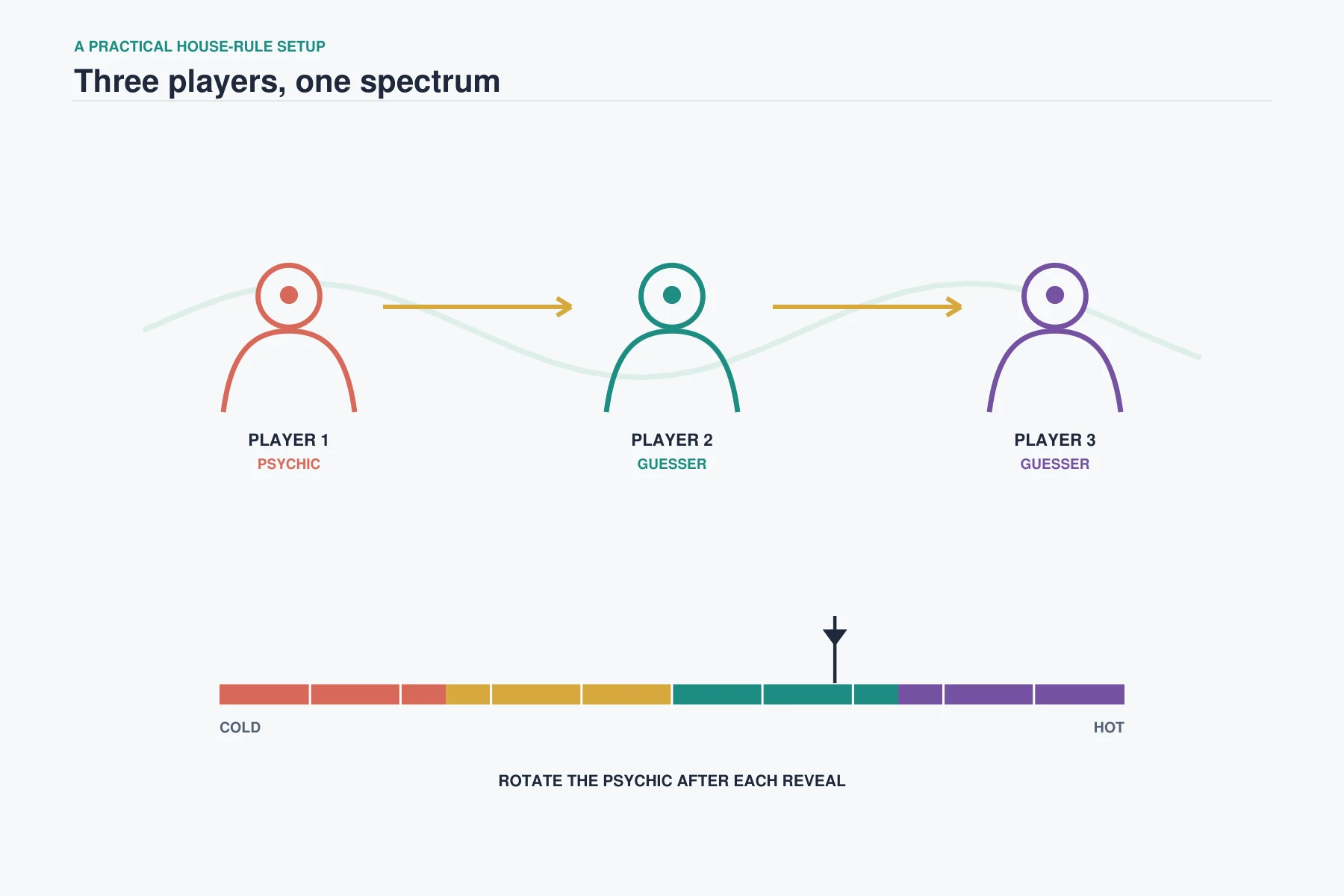
Editorial Wavelength diagram with one Psychic, two guessers, and a target on a cold-to-hot spectrum
A three-person house-rule round has one clue giver and two guessers working toward one locked answer.

Can You Play Wavelength With 3 Players?

Yes. Use one shared team: one Psychic gives a clue, two guessers discuss one position, then the role rotates after the reveal. This gives the third player a full turn without making a permanent one-versus-two matchup.

Choose individual guesses if players prefer personal scores, and lock both positions before the reveal. Treat either format as a house rule and follow your edition's printed scoring.

Best Three-Person Setup: One Psychic, Two Guessers

Before the first round, pick a score format and agree that only one person will see the target. Use a clear spectrum with a meaningful middle, such as cold to hot or boring to exciting. A clue should suggest a place on that line; it should not name the hidden answer or reveal the exact position.

RoleWhat to doWhat to avoid
PsychicRead the target privately and give one clue that points toward its position.Adding a second clue, pointing at the dial, or reacting to the guess.
Guesser AExplain one interpretation of the clue and help choose a shared position.Moving the marker before the group has discussed the scale.
Guesser BOffer a different example or counterpoint, then help lock the team decision.Turning the discussion into a vote with no reason behind it.

Let each guesser offer one example, compare where those examples sit on the spectrum, then lock one position. The Psychic stays quiet so the team reads the clue rather than the Psychic.

Three-Player Wavelength Rules Step by Step

1
Choose a format
Use one shared team guess for a relaxed game, or give each guesser a separate locked guess if you want individual scores.
2
Hide the target
Only the Psychic looks at the target area. The other two players should wait until the dial or screen is hidden.
3
Give one clue
The Psychic gives one word or short phrase that fits somewhere between the two ends of the spectrum.
4
Discuss and lock
The guessers explain their readings and place one marker, or record two guesses if using the individual option.
5
Reveal and rotate
Reveal the target, score the result, and make the next player the Psychic.

In co-op, one person moves the marker after agreement. For individual scoring, each guesser writes or privately sends a position before either answer is revealed.

Fair Scoring and Role Rotation for 3 Players

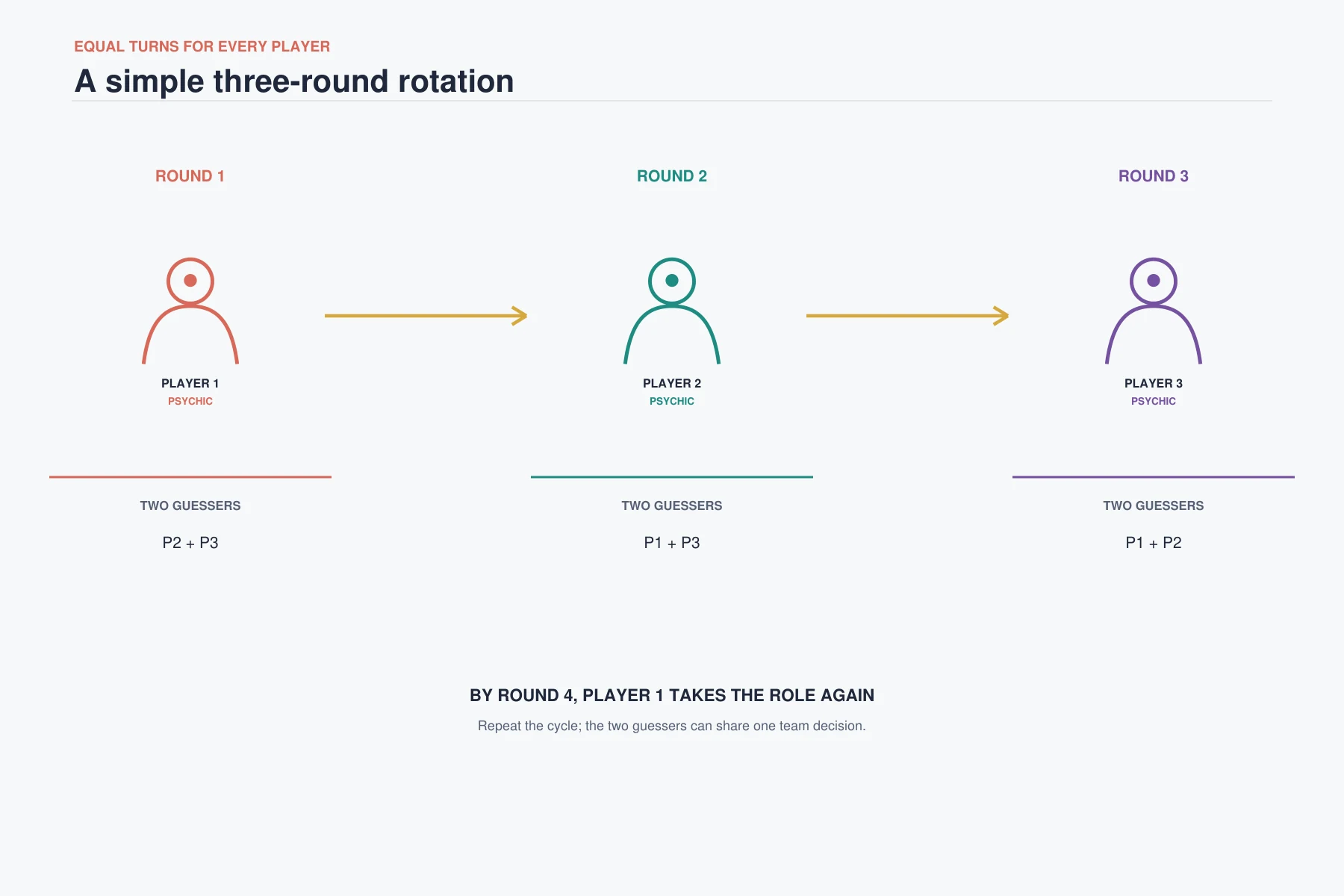
Play three rounds so everyone gives one clue, six for two Psychic turns each, or nine for a longer session. Keep the order fixed; rotating the starting player is optional.

Agree on scoring first. This site's browser board uses 5/3/1/0 zones; a physical copy may differ, so follow its rule sheet. In co-op, total the shared score over equal rounds.

RoundPsychicGuessersAfter reveal
1Player 1Players 2 and 3Record shared points
2Player 2Players 1 and 3Record shared points
3Player 3Players 1 and 2Cycle back to Player 1
Three-round Wavelength role rotation where each of three players becomes the Psychic once
Keep the same order throughout the game: each player is Psychic once, while the other two guess together.

Co-op or Individual Guesses: Which Is Better?

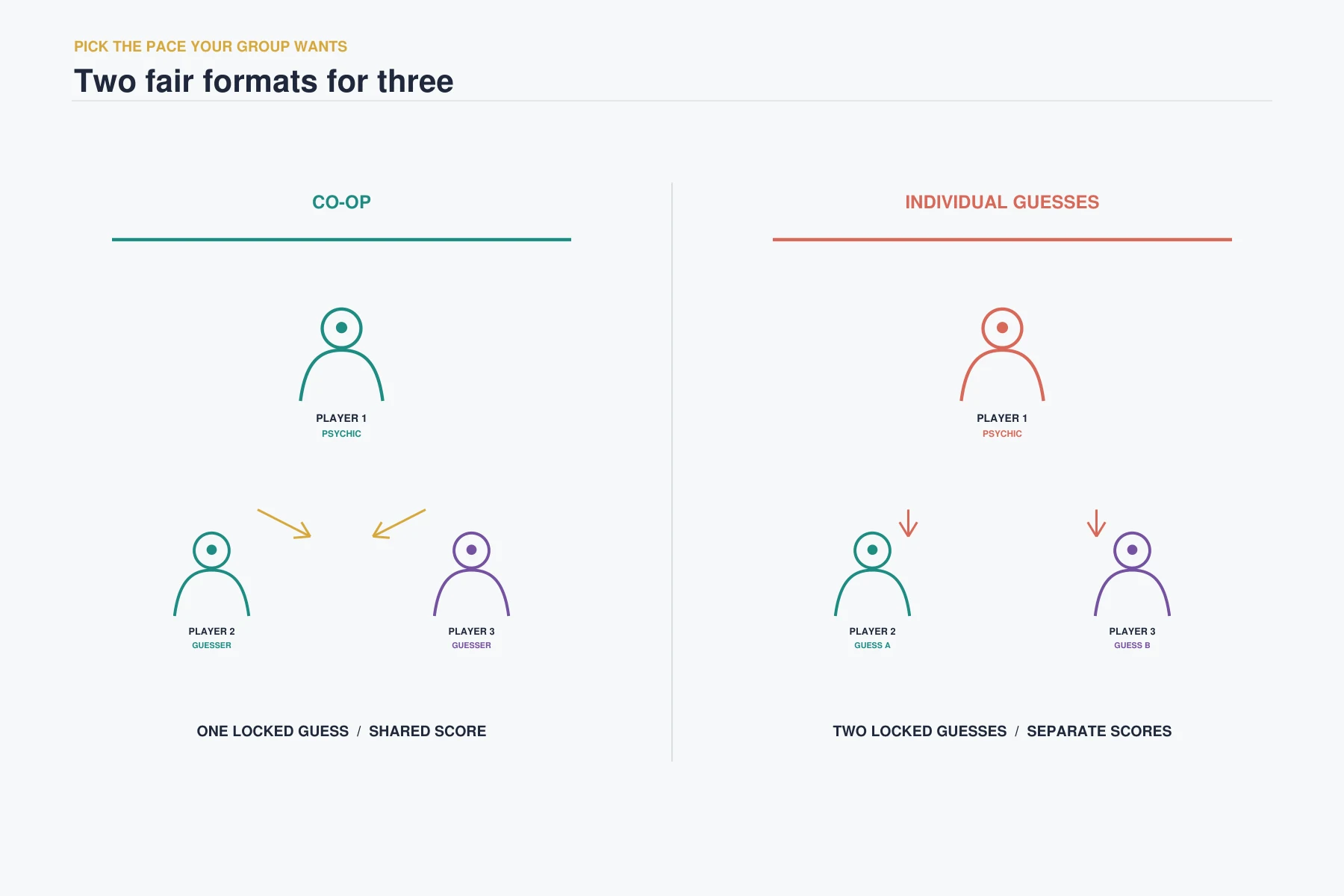
Co-op is the simplest start: two guessers discuss one answer and share the result. Choose individual guesses when the group wants to compare interpretations instead of building consensus.

FormatHow guesses workBest forTradeoff
Co-opTwo guessers discuss and lock one shared position.First games, couples plus a friend, casual game nights.One person's score represents the whole group.
IndividualBoth guessers independently lock a position before reveal.Friendly competition or comparing how each person read a clue.The Psychic has no guess that round, so rotate the role and compare equal numbers of turns.
Editorial comparison of a shared co-op Wavelength guess and two independently scored guesses
Use one shared answer for a cooperative session, or two locked answers when each guesser wants a personal score.

For individual play, score each guess separately and rotate the Psychic after every reveal. Over three rounds, everyone gives one clue and guesses in the other two rounds.

Example: How One Three-Player Round Works

Imagine Player 1 is Psychic and sees a target well toward the “hot” end of a cold-to-hot spectrum. They say “fresh coffee.” Player 2 thinks a warm mug is only moderately hot, while Player 3 pictures a very hot espresso. The two guessers compare those examples, agree that the clue sits around two-thirds of the way toward “hot,” and lock the marker there.

Reveal only after the marker is locked, then score with the agreed zones. Compare how each guesser interpreted “fresh coffee”; that debrief can help the next Psychic choose a clearer clue.

Accept reasonable misses as feedback about the group's shared scale. Do not let the Psychic add hints or repeat clues until the target is reached.

How to Play Wavelength Online With 3 Players

In person, one board is enough: the Psychic checks and hides the target, then the guessers discuss and move the marker. For a remote call, the Psychic can host, inspect the target privately, hide it before screen sharing, and stay neutral while the other two settle their answer.

On this site's free Wavelength game board, agree who controls the dial before starting. If the hidden target is visible during a call, pause sharing while the Psychic checks and hides it.

Six turns gives each person two Psychic turns. If a friend joins, switch to the four-player 2v2 setup; for two people, use the two-player cooperative rules.

Prompts That Work Well With Three People

Start with familiar spectra that all three players can place between the endpoints; avoid clues only one person understands.

  • Cold to hot: good for simple clues such as drinks, weather, or food.
  • Cheap to expensive: useful when players can compare familiar purchases.
  • Boring to exciting: flexible enough for hobbies, films, and everyday events.
  • Safe choice to wild risk: creates debate without specialist knowledge.

Once everyone understands the format, try subjective scales and compare interpretations. For more ideas, browse the Wavelength prompts list or make a private theme with the custom prompt guide.

Common Three-Player Mistakes

Letting the Psychic join the guess. They have seen the target, so keep reactions and extra comments neutral until the reveal.

Changing the score after a miss. Choose zone values or a simple close/miss score before round one and use it throughout.

Turning co-op into a race. Both guessers should contribute before the shared answer is locked; do not award points for speaking first.

Using uneven teams by default. One versus two can feel lopsided. Use individual locked guesses for a clearer three-person contest.

Playing too long at first. Start with three or six rounds, then extend to nine once role changes feel natural.

Wavelength for 3 Players FAQ

What is the best Wavelength setup for 3 players?▼
Start with one Psychic, two guessers who agree on one position, a shared score, and a role rotation after every reveal. It keeps all three people involved without uneven teams.
How do you rotate roles in a three-player Wavelength game?▼
Use Player 1, Player 2, then Player 3 as Psychic. The other two guess each round. After the third reveal, repeat the same order.
Can three people play Wavelength cooperatively?▼
Yes. The two guessers can act as one team, make a shared decision, and try to reach a target score over a fixed number of rounds.
Can you play Wavelength with 3 players online?▼
Yes. One player can host the browser board, inspect and hide the target before sharing, and let the other two discuss a locked guess over voice chat.
How many rounds should a three-player game last?▼
Play three rounds for a quick test, six rounds for a short balanced game, or nine rounds when everyone wants three Psychic turns.

Rules Note and Related Guides

The rotating triad and separate-guess option on this page are house-rule formats written for a group of three. They are not presented as official rules for every edition. For physical components or edition-specific instructions, check the rule sheet included with your copy and the publisher's Wavelength product information.

For the general turn sequence and scoring context, continue to the complete How to Play guide. If your group changes size, use the 2-player cooperative setup or 4-player team rules.

Start a Three-Player Round

Choose a spectrum, rotate the Psychic, and see how two guessers read the same clue.

Open the Wavelength Game