Wavelength Game Strategy: Better Clues, Guesses, and Team Reads
Learn a repeatable way to calibrate one clue, discuss a realistic target range, and make a confident guess without turning every round into a debate marathon.
A practical Wavelength game strategy keeps clue-giving and guessing as two separate jobs: the Psychic supplies one well-calibrated anchor, while the team explains how that anchor maps to the scale.
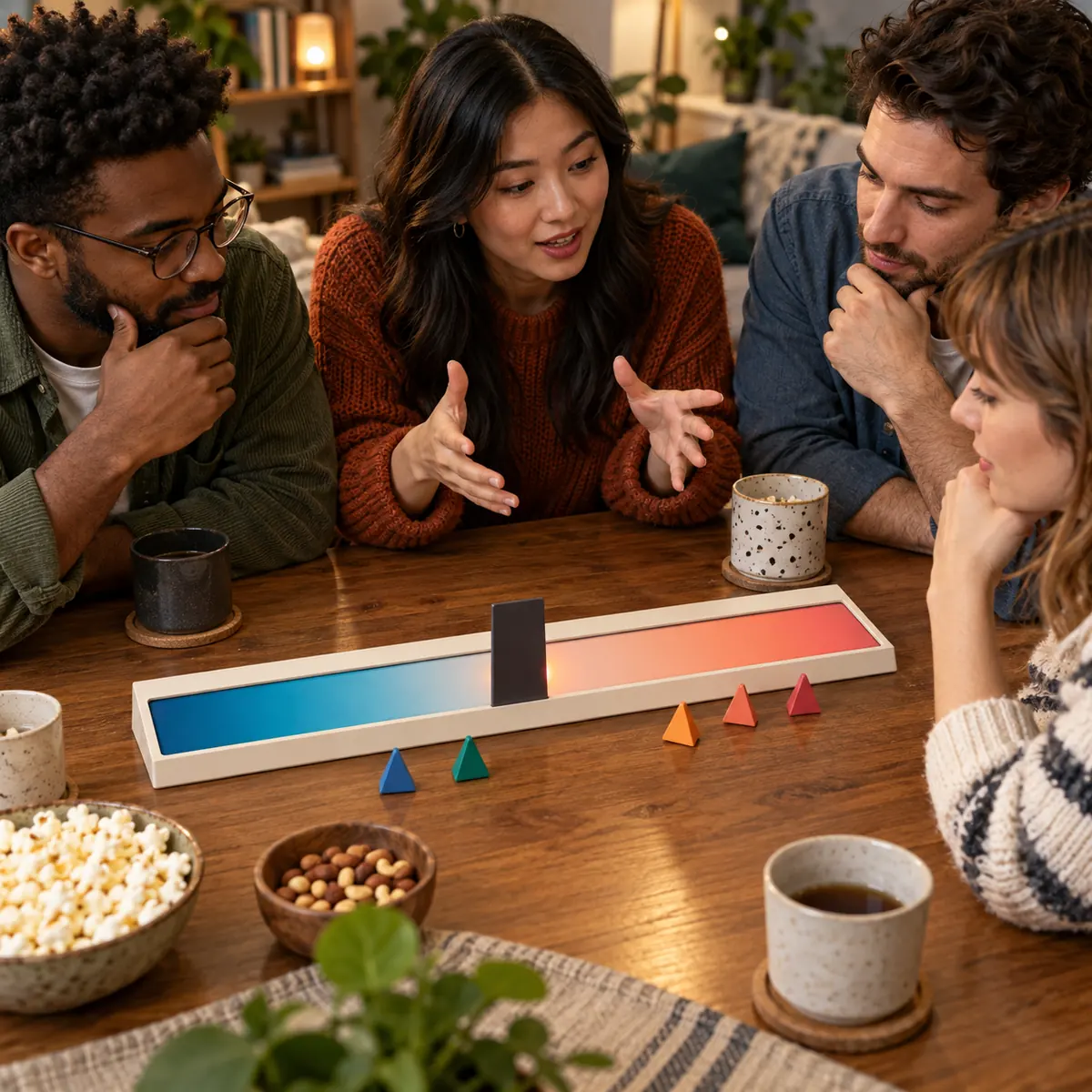
1. Wavelength Game Strategy Starts With the Spectrum
Every round has two endpoints and a hidden target somewhere between them. The target is not simply left or right; it has a degree. A clue that feels perfect for the far end may be too intense for a target near the middle. Before speaking, translate the board into a rough position: left third, center band, right third, or close to an endpoint.
This Wavelength game strategy starts with the scale rather than a memorized trick. Identify what counts as a moderate example for this group, then compare the hidden zone against that shared baseline.
Then ask what the endpoints mean to this particular group. “Boring to exciting” is not a fixed measurement. A quiet museum, a long airport delay, and a surprise concert might land differently depending on who is playing. Your first strategic job is to find a reference that your team can place without a long explanation.
If you want a quick reminder of the turn order, use the How to Play guide first. This page assumes you already know the Psychic, discussion, guess, reveal, and scoring sequence.
2. Psychic strategy: make one clue do useful work
The Psychic sees the target but cannot point to it. A Wavelength game strategy uses one reference clue that leaves enough uncertainty for real discussion. Check that the clue is specific, calibrated, and shared before saying it:
For the Psychic, a useful Wavelength game strategy is to choose one example that narrows the possible zone without turning the clue into an explanation of the hidden target.
- Specific: Can the table picture one thing instead of a vague adjective?
- Calibrated: Does its intensity match the target zone rather than one of the endpoints?
- Shared: Will most players know the reference, or will the clue require a private backstory?
Anchor the clue, then stop talking
Concrete nouns usually beat abstract labels. On a cold-to-hot spectrum, “a warm shower” gives a different anchor from “a summer day.” On a cheap-to-expensive spectrum, “a supermarket birthday cake” creates a more usable reference than “not too costly.” Choose the example, give it once, and let the team do the placement work.
Match the clue's energy to the target
Extreme targets deserve extreme references. A clue like “freshly baked bread” may fit warm, but “inside a volcano” is too far toward hot for most groups. For a central target, choose something that naturally has mixed qualities. Moderate clues create a wider, more honest discussion and reduce the temptation to guess an endpoint.
Protect the one-clue rule
Do not add a second hint through a pause, facial expression, or “you know what I mean.” Extra signaling makes the round about reading the Psychic rather than interpreting the spectrum. If the table asks a follow-up, repeat the clue and let the team own the uncertainty.
3. Guesser strategy: build a range before placing the marker
A Wavelength game strategy for guessers starts with ranges, not exact spots. Ask each player to name a left and right edge, then look for overlap. If one person says 45–55 and another says 60–70, discuss why their references differ instead of debating who sounds certain.
For guessers, the Wavelength game strategy is to compare ranges before numbers. Once players explain their anchors, the overlap often becomes clearer than a vote for one exact marker.
Have the first speaker explain the assumption behind the position. “I hear warm shower as 60 because I compare it with bathwater” is more useful than “I think it is 60.” A short explanation lets the team correct a mismatch without shutting down a quieter player.
| Clue feeling | Start your range | Discussion question |
|---|---|---|
| Clearly left, but not extreme | 20–40 | What would make this reference even colder, cheaper, or safer? |
| Balanced or ambiguous | 40–60 | Which part of the clue feels stronger than the other? |
| Clearly right, but not extreme | 60–80 | What would push this example closer to the endpoint? |
| Near an endpoint | 10–25 or 75–90 | Is the clue truly extreme, or are we anchoring on a vivid word? |
After two or three voices, choose the position that best fits the overlap. Avoid endless averaging when a player offers a new interpretation without evidence. A useful team debate gets narrower over time; if the range keeps growing, restate the endpoints and choose the most defensible middle of the remaining range.

4. Wavelength Game Strategy and Scoring Risk
The usual scoring pattern rewards a bull's-eye most, then gives smaller rewards for nearby zones. That creates a real choice: chase a narrow high-value guess or take the center of a wider range. The right decision depends on how much evidence the clue gives and how the score is moving.
The scoring part of a Wavelength game strategy is a risk decision: take precision when the shared reference is strong, and protect the likely close zone when the clue supports several readings.
| Situation | Better choice | Why |
|---|---|---|
| The clue has one shared, vivid reference | Take the narrow center | Everyone is likely using a similar anchor, so precision is justified. |
| Players agree on a side but not the exact point | Choose the middle of the overlap | You preserve a close score without pretending to know more than the clue says. |
| The clue is abstract or unfamiliar | Choose a safer central position | A broad interpretation makes an edge guess fragile. |
| Your team is far behind late in the game | Accept calculated risk | A narrow guess may be worth it when a safe score cannot catch up. |
Do not let the score erase the social part of the game. A missed bull's-eye can still be a great round when the team discovers that two people use the same word differently. Record the score, then keep the conversation moving.
5. A simple strategy routine for every round
- Scan: Psychic identifies the target band and the strength of the two endpoints.
- Anchor: Psychic picks one familiar example that fits the band.
- Listen: Guessers each give a short range and the assumption behind it.
- Narrow: Team finds the overlap and checks for one obvious outlier.
- Lock: Place the marker, stop revising, reveal the target, and note what the group learned.
This routine keeps a round fast without making it shallow. It also gives new players a clear role. If the group needs more ready-to-read situations, the Wavelength game questions page provides prompts; use this strategy loop to decide where each clue belongs.
6. Remote and mixed-group strategy
Online rounds work best when one host shares the board and the team uses voice chat for the clue discussion. Keep the target hidden, ask players to speak in order, and have the host repeat the final range before locking it. This prevents a fast connection or a louder microphone from deciding the guess.
For mixed groups, avoid references that only one person knows. If a clue depends on a niche show, inside joke, or local food, invite the Psychic to choose a more universal anchor. You can also use the team-building guide for a work-safe format, then apply the same range-setting method.
7. Mistakes that make a good clue harder to read
- Vague adjectives: “Nice” or “bad” gives no usable reference point.
- Endpoint clues: An extreme word can push every guess too far.
- Private references: A clue only one player understands creates noise, not insight.
- One-person control: The first confident voice should not end the discussion.
- Endless averaging: A team still needs to lock a defensible range.
- Changing after reveal: Keep the original reasoning so the group can learn from it.
8. Practice examples: turn a clue into a range
Use these examples as calibration drills before a game. The goal is not to memorize a “correct” number; it is to compare how your group places the same reference.
| Spectrum | Clue | What to discuss |
|---|---|---|
| Quiet room → loud room | A library study table | Is the group picturing a silent library or a busy one? Start left of center. |
| Everyday → extravagant | A hotel breakfast buffet | Decide whether the reference is a basic spread or a luxury version. |
| Harmless → risky | Riding a bike in light rain | Separate inconvenience from genuine danger before moving right. |
| Boring → exciting | A surprise museum exhibit | The surprise adds energy, but the subject still sets the baseline. |
To create more drills, use the Wavelength game generator, choose a prompt, and have everyone write a range before the Psychic reveals the target. Comparing the written ranges makes team patterns easier to spot.
Wavelength game strategy FAQ
What is the best Wavelength game strategy?
Use a familiar reference that matches the target's intensity, then let the team discuss a range before placing the guess. Calibrated communication is more reliable than trying to invent a secret code.
How can I give better Wavelength clues?
Choose one concrete reference your group understands, match its strength to the target zone, and avoid extra hints through gestures or follow-up comments.
Should a team always guess the middle?
No. Use the middle when the clue feels balanced or uncertain. Move toward a side when the team can explain why the reference belongs there.
How do you play Wavelength strategically online?
Use one host screen, keep the target hidden, give each player a short turn to explain a range, and lock the guess before revealing the target.
Is it better to play safe or chase five points?
Choose the center of the overlap when evidence is weak. Chase a narrow bull's-eye only when the group shares a strong reference and the clue supports that precision.