
Wavelength Game Team Building: Questions & Hosting Guide

A practical, low-pressure way to get a team talking about how it thinks.

Work-safe prompts20–35 minutesRemote-friendlyNo download
Quick answer: Wavelength game team building works best when one facilitator gives a neutral spectrum, one person gives a clue, and the group agrees where that clue belongs. Use the debate to reveal different assumptions, then debrief the reasoning. Keep the target hidden until the guess is locked, and treat the score as a conversation starter rather than a performance grade.
Diverse workplace team discussing a colorful Wavelength spectrum at a table
A concept illustration of a workplace Wavelength session, not an official product screenshot.

If you searched for wavelength game team building, you probably need an activity that starts quickly but still gives people something useful to discuss. Wavelength fits that brief because the rules are small: two opposite ends, one hidden target, one clue, and one shared guess.

The useful part is not guessing a perfect position. It is hearing why a colleague places the same clue near “careful plan,” “quick experiment,” “quiet room,” or “busy room.” Those explanations make working preferences visible without asking anyone to share a personal story. A facilitator can run a round in a meeting room, classroom, retreat, or video call.

This guide separates team facilitation from a general Wavelength rules guide and from the site's broad Wavelength prompts list. Use those pages for the complete game or a large prompt bank; use this page when the audience is a team and the host needs a safe, repeatable session.
Why Wavelength Game Team Building Works

Most icebreakers ask people to perform a prepared answer. Wavelength asks them to interpret a shared clue. That small change creates a more natural conversation: people can disagree, explain a trade-off, and notice how another person frames a decision.

The spectrum also gives the facilitator a built-in boundary. A prompt such as Detailed plan ↔ Quick experiment stays about a work choice. It does not require anyone to disclose a weakness, reveal a private opinion, or compete in a trivia contest. New teams can start with concrete topics, while experienced groups can move toward collaboration habits.

Keep the activity short enough that the discussion stays energetic. Four to eight people can usually complete four or five rounds in 20 to 35 minutes. For a larger group, split into small teams or use one shared guess per table, then compare the reasoning rather than creating a long leaderboard.

What the Facilitator Needs Before the First Round

Prepare the room before asking people to participate. Choose a host, set a time limit, and tell the group that passing is allowed. If you are using the online Wavelength board, keep one browser tab ready and decide who can see the target. For an in-person session, a whiteboard or paper scale is enough.

ItemSimple choiceFacilitator note
Group size4–8 people or small tablesEveryone needs a chance to explain a reading without turning one clue into a meeting.
Time boxFour rounds plus a five-minute debriefA visible end time makes the activity feel safe inside a busy agenda.
Target ownerOne Psychic per roundThe Psychic sees the target, gives one clue, then stays neutral until the reveal.
Prompt levelConcrete, work-safe and debatableDo not use salary, politics, health, relationships or a real colleague as a spectrum end.
ScoringShared points or no leaderboardExplain that the score measures a guess, not a person's communication ability.

10 Work-Safe Wavelength Questions for Teams

Pick one spectrum, then give the Psychic a moment to think. The best team-building questions have a clear direction and a rich middle. They invite examples without forcing a confession.

Async updates ↔ Live discussion
Good for teams choosing how much meeting time a task needs.
Detailed plan ↔ Quick experiment
Useful when a group is comparing planning and iteration.
Quiet workspace ↔ Busy workspace
Lets people explain focus preferences without judging them.
Specialist ↔ Generalist
Creates a gentle conversation about depth, range and collaboration.
Customer request ↔ Product vision
Works for product teams discussing trade-offs.
Short message ↔ Full context
Helps a team name what makes written communication useful.
Early feedback ↔ Polished draft
Good for comparing when people prefer to share work.
Routine ↔ Novelty
Invites examples about process changes without naming a person.
One owner ↔ Shared ownership
Useful for discussing handoffs and decision clarity.
Fast decision ↔ Deliberate decision
Reveals how the team balances speed and confidence.
Facilitator rule: avoid a prompt whose “right” side is obvious. If everyone must choose the same endpoint, there is no useful spectrum. Rephrase it until both sides sound reasonable and the middle can hold several honest interpretations.

How to Run a Wavelength Team-Building Round in 6 Steps

Read the sequence once before starting. A predictable rhythm lets the facilitator focus on the discussion instead of explaining rules again.

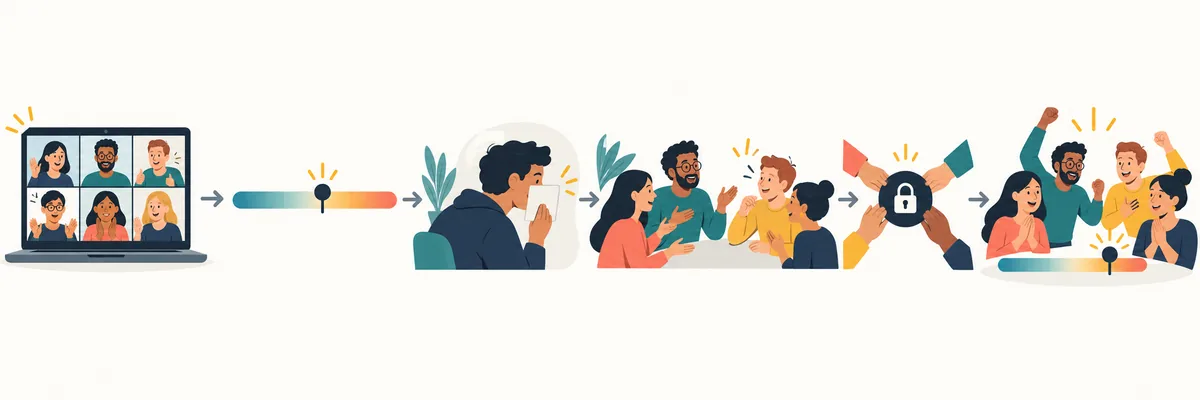
1. Set the spectrumRead both ends and give one concrete example of what the middle could mean.
2. Show the target privatelyLet the Psychic see the hidden position, then return the board or card to a neutral view.
3. Give one clueThe Psychic says one word or short phrase. No second hint, facial cue or correction.
4. Discuss the meaningInvite two or three different readings. Ask for reasons, not a rapid vote.
5. Lock one guessChoose one position and stop moving it. A time box of two minutes keeps the debate focused.
6. Reveal and reflectShow the target, note the score if you use one, and ask what assumption separated the readings.
Editorial flow showing remote host, private target, team discussion, locked guess and reveal
A visual reminder of the remote round order: prepare, hide, clue, discuss, lock and reveal. It is an explanatory illustration, not a live interface.

Choose the Format for Your Group

Keep the core turn the same, then adjust the number of voices and the debrief. The goal is a conversation that fits the setting, not a perfect tournament format.

SettingRecommended formatSmall adjustment
Small office teamOne shared guess and rotating PsychicAsk each person for one reason before the final decision.
Remote teamOne host shares the board; everyone uses a voice callUse names in the speaking order and keep the target hidden from screen share.
Workshop or classSmall tables choose separate positionsCompare why tables landed differently instead of declaring one winner.
Large retreatSeveral short stations with the same prompt setGive each station a facilitator and a visible two-minute discussion timer.

Debrief Without Turning It Into a Performance Review

The reveal is a useful pause, not the end of the activity. Ask what made the clue feel low, middle or high. Then ask which assumption differed and what information would have made the group converge sooner. These questions turn a playful miss into a practical conversation about context and communication.

Keep the debrief about the prompt and the reasoning. Do not ask who “understood the Psychic” or use the result to evaluate a colleague. If a prompt drifts into personal territory, stop the round, offer a neutral replacement, and remind the group that passing is always acceptable.

For remote sessions, repeat the clue in chat only after the Psychic has finished speaking, and do not let a late arrival see the target. For mixed-experience teams, demonstrate one practice round with a low-stakes spectrum such as Tea ↔ Coffee. After the session, link to the site's custom prompt tool if the team wants to build a private set for future meetings.

Simple closing question: “What did this round show us about how we interpret the same information?” It invites learning without asking anyone to defend a personal preference.

Wavelength Team Building FAQ

Is Wavelength a good team-building game?

Yes. The format is quick to explain, supports disagreement without a right answer, and gives people a shared object to discuss. It works best when prompts are neutral and the host makes passing acceptable.

How long should a session be?

Plan 20 to 35 minutes for four to eight people, including one practice round and a short debrief. In a meeting, choose a fixed number of rounds so the activity ends on time.

What questions are safe for work?

Use work choices, communication habits, environments and process trade-offs. Avoid salary, politics, health, relationships, protected traits, and prompts that point at an identifiable coworker.

Can a remote team play together?

Yes. One host can share the online board while the team uses Zoom, Meet or Discord for the clue and debate. Hide the target from screen share until the final guess is locked.

Should a facilitator keep score?

A shared score can give the group a light structure, but it is optional. Use the reveal to compare interpretations rather than ranking people or treating points as a measure of communication skill.

What is a useful debrief question?

Ask what made the clue feel low, middle or high, which assumption differed, and what extra context would have helped. Keep the focus on communication and the prompt.

Start With One Safe Round

Choose a familiar spectrum, explain the hidden-target rule, and let the team debate for two minutes. A good Wavelength team-building session does not need a clever winner; it needs a clear clue, a fair turn, and enough space for people to explain how they got there.

Ready to host a round?

Open the free browser board, choose a work-safe prompt, and invite the group to make one shared guess.

Play Wavelength Online