Wavelength Board Game Review: Is It Worth It?

An evidence-led verdict on the physical party game, its best player count, replay value, component quality, and the groups most likely to love it.

Honest Pros & Cons2–12 Players30–45 Minutes
Quick verdict: Wavelength is worth buying for talkative groups that enjoy creative clues and friendly disagreement. It is unusually easy to teach, quick to set up, and strongest with about 6–8 players. Skip it if your group wants deep tactical control, dislikes subjective debate, or usually plays as a quiet pair. The wheel is memorable, but the conversation—not the scoring—is the real product.
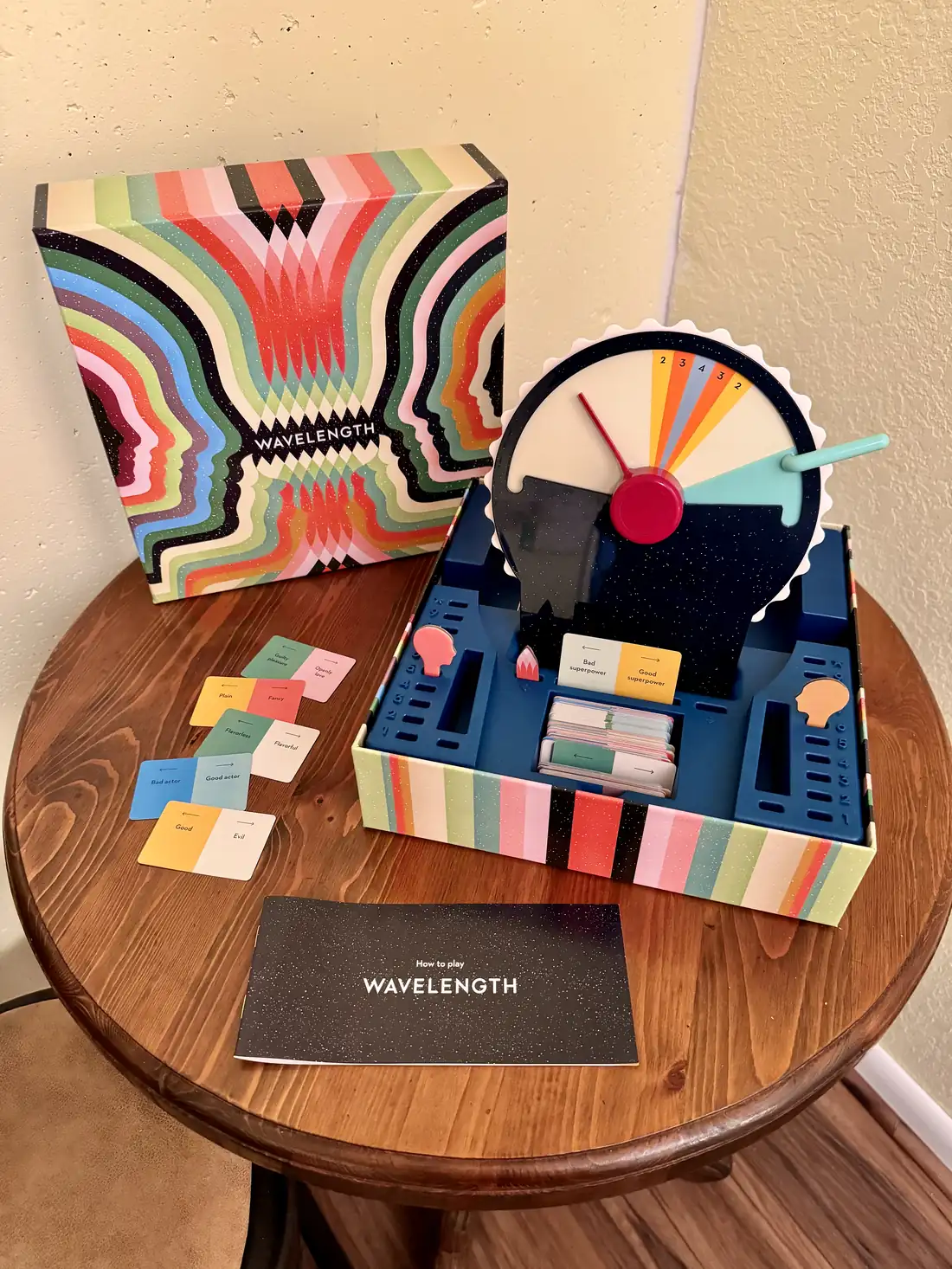
Wavelength board game box, spectrum wheel, cards, and scoring pieces arranged for play
Real Wavelength board game components photographed by Harrison Keely, cropped and compressed for this review. Source: Wikimedia Commons, CC BY 4.0.

This Wavelength board game review focuses on the buying decision rather than repeating the full rulebook. The official product listing describes a 2–12 player game for ages 14+ with an average play time of 45 minutes. At the table, one player—the Psychic—tries to guide teammates toward a hidden location on a spectrum using one clue. The reveal produces points, but the arguments about where a clue belongs produce most of the fun.

If you already own the game and only need instructions, use our complete Wavelength rules guide. To try the core spectrum idea before buying, you can also play Wavelength online in the browser.

FactOfficial specificationWhat it means in practice
Players2–12Competitive team play becomes much more lively around 6–8; 2–3 works better with the cooperative rules.
Age14+The mechanism is simple, but some spectrum cards and cultural references suit teens and adults better.
Play timeAbout 45 minutesA focused group may finish in 30 minutes; long clue debates can extend the session.
PublisherCMYKThe physical edition centers on a distinctive wheel, screen, dial, cards, and scoring markers.
Core appealTeam mind-reading party gameSuccess depends more on knowing how people think than on trivia knowledge or fast reflexes.

Our Wavelength Review Verdict

Learning curve: ExcellentThe core turn can be explained in a minute or two, so new players contribute almost immediately.
Social energy: ExcellentEvery clue invites interpretation, stories, and disagreement instead of leaving players silently waiting.
Strategy: LightThere is skill in clue calibration and reading teammates, but little long-term planning or tactical control.
Small-group fit: MixedThe cooperative mode works, yet the game loses some spark when there are too few opinions to debate.

The strongest reason to buy Wavelength is that it creates a specific kind of interaction with very little friction. A clue such as “coffee” on a Cold ↔ Hot spectrum sounds obvious until six people argue about iced coffee, safe drinking temperature, and whether the Psychic meant espresso. That gap between a clue giver's intention and the team's interpretation is funny, revealing, and highly replayable.

The weakness is the same mechanism viewed from the other side. Wavelength cannot manufacture chemistry. A group that dislikes debate may treat every round as a quick dial placement and miss the point. A dominant player can also flatten discussion unless the host actively invites quieter people in. This is a social experience with scoring attached, not a strategy game that happens to include conversation.

Wavelength Board Game Pros and Cons

Pros

  • Fast setup and teach: the wheel stays organized in the box insert, and the basic turn is easy to demonstrate.
  • Natural participation: teammates have a reason to explain their thinking instead of waiting for one expert to solve the puzzle.
  • High prompt replayability: the target changes even when a spectrum card repeats, so old cards generate new clues.
  • Flexible group size: competitive and cooperative formats cover a wider range than many party games.
  • Memorable physical reveal: opening the screen to expose the scoring zone gives each round a satisfying finish.

Cons

  • Group-dependent fun: quiet, impatient, or overly literal players may not enjoy the discussion that drives the game.
  • Limited strategic depth: experienced hobby gamers looking for layered decisions may find it too light.
  • Uneven voices: louder teammates can steer every guess unless the group makes space for everyone.
  • Awkward at two: the official cooperative variant is playable, but two people create fewer surprising interpretations.
  • Bulky for its weight: the wheel is attractive and functional, yet less portable than a deck-only party game.

What Is the Best Player Count for Wavelength?

Six to eight players is the safest recommendation. Two teams of three or four provide enough opinions for real debate without turning each clue into a meeting. This aligns with several established reviews, while the official range remains 2–12 players.

Group sizeRecommended modeReview verdict
2 playersCooperativePlayable for couples who know each other well, but not the best reason to buy the box.
3 playersCooperativeBetter than forcing uneven teams; enjoyable when everyone likes clue discussion.
4 players2v2 or cooperativeGood, especially with role rotation. See the four-player setup guide.
6–8 playersTwo teamsBest balance of varied interpretations, manageable discussion, and regular turns.
9–12 playersTwo large teamsExcellent party energy, though a host should prevent one or two voices from controlling the dial.
12+ playersLarge teams or house formatPossible informally, but conversation and turn ownership need more structure than the listed player range.
Planning a game night? Our Wavelength game length guide shows how group size, score targets, and discussion time change a 15-, 30-, or 45-minute session.

Components, Table Presence, and Setup

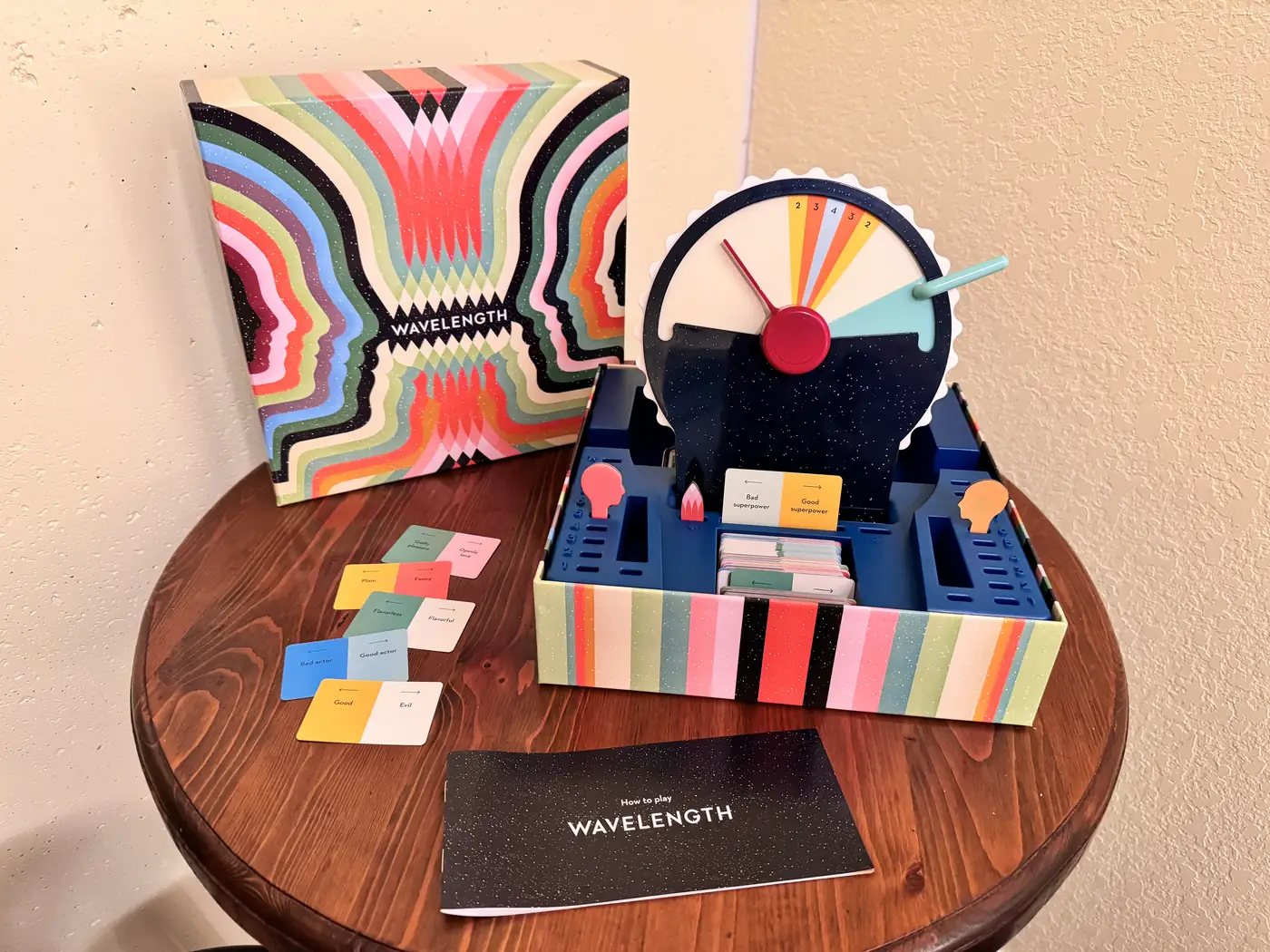
The physical device is Wavelength's clearest advantage over a homemade scale. The dial gives the guessing team a precise decision to make, the screen hides the target, and the colored scoring wedges make the reveal readable from across a table. The box insert doubles as the support structure, so setup is closer to opening and positioning the game than assembling a board.

The production also explains why the box is larger than the rules complexity suggests. You are paying for a tactile centerpiece rather than a large strategy-game system. If portability matters more than the reveal, the browser version or mobile app may be more practical. If you want a centerpiece that draws a room toward the table, the physical wheel earns its space.

Wavelength physical wheel with scoring zones, spectrum cards, box insert, and rulebook
The physical wheel, scoring zones, prompt cards, and insert that create Wavelength's table presence. Photo by Harrison Keely, technically resized and compressed. Source · CC BY 4.0.

Replay Value and Value for Money

Replay value is strong because the spectrum card is only the frame. A random target position changes the clue, and a different Psychic changes the assumptions behind it. Familiar groups develop callbacks and shared reference points; new groups create uncertainty because players cannot rely on personal history. Both situations produce different games from the same cards.

Asmodee USA listed the physical game at $38.99 when checked on July 25, 2026, while retail prices and stock can change. That price is easier to justify for hosts who regularly gather six or more people. A household that mostly plays with two may get more value from a dedicated two-player title and use a digital spectrum game occasionally.

Custom content extends the concept further. Our 200+ Wavelength prompts list supplies extra spectra, while the Wavelength game generator can create a quick round without preparing cards.

Physical Wavelength vs Online Wavelength

Decision factorPhysical board gameOnline version
Best settingIn-person parties and game nightsRemote calls, quick trials, classrooms, and no-prep play
FeedbackTactile dial and dramatic screen revealAutomatic target, scoring support, and easy screen sharing
CostOne-time retail purchaseOur browser version is free to play
PortabilityLarge box with a dedicated deviceWorks wherever players have a browser and a shared conversation channel
Best reason to choose itYou want the official table centerpieceYou want to test the concept or play immediately with remote friends

The formats do not need to compete. Try the free online Wavelength game first; buy the physical edition if your group responds to the discussion and you want the tactile reveal at recurring in-person events.

Who Should Buy Wavelength?

Buy it if…

  • You regularly host six or more friends, family members, coworkers, or mixed-experience players.
  • Your group likes Codenames-style clue giving but wants more open conversation and fewer right-or-wrong answers.
  • You need a party game that teaches quickly and lets late arrivals join without learning a complex system.
  • You enjoy games where disagreement and storytelling are part of the reward.

Skip it if…

  • Your regular group is two players and you want tight head-to-head strategy.
  • Your players dislike subjective judgments or become frustrated when a clue has no objectively correct placement.
  • You want a compact travel game or a quiet puzzle that does not depend on group chemistry.
  • You expect a deep competitive system where careful long-term decisions outweigh social intuition.

Bottom line: Wavelength is one of the more distinctive modern party games because it turns differences in perspective into the main event. For the right group, that creates repeatable laughter with almost no rules overhead. For the wrong group, the beautiful wheel cannot replace a missing appetite for conversation.

Wavelength Board Game Review FAQ

Is the Wavelength board game worth it?
Yes for talkative groups that regularly play with about 6–8 people. It offers quick setup, simple rules, a memorable physical reveal, and strong replay value. It is less compelling for pairs or groups that prefer deep strategy over subjective discussion.
What is the best number of players for Wavelength?
Six to eight players split into two teams is the most reliable setup. The official range is 2–12, and cooperative rules make 2–3 players possible, but larger teams create more of the debate that makes Wavelength special.
How long does Wavelength take?
The official average is about 45 minutes. Many groups finish in 30–45 minutes, depending on player count, how long clue discussions run, and whether the group plays to the standard score target.
Is Wavelength good with two players?
The cooperative mode works with two, especially for a couple that enjoys comparing perspectives, but the game has fewer surprising interpretations without a larger discussion. It is playable rather than ideal.
Is Wavelength like Codenames?
Both use clues and team interpretation, but Wavelength asks players to locate a clue on a continuous spectrum. Codenames is more about identifying specific words, while Wavelength is more about debating degrees and perspectives.
Can I try Wavelength before buying it?
Yes. You can use this site's free browser game to test the spectrum-and-clue format with your group. The physical edition adds the official wheel, cards, scoring pieces, and tactile reveal.

Sources and Media Credits