How Long Is a Game of Wavelength?

A practical timing guide for tabletop games, online rounds, remote groups, classrooms, and party hosts.

30 Minute Baseline Round Timing Group Size Tips Online Host Plan
Fast answer: a normal game of Wavelength takes about 30 minutes. Many tabletop listings put the game in the 30 to 45 minute range, while a quick online version can take 10 to 20 minutes if you play fewer rounds and keep discussion short. The biggest timing factors are group size, how long teams debate each clue, whether players already know the rules, and whether you stop at a target score or a fixed number of rounds.

The Short Answer: Plan for 30 Minutes

How long is a game of Wavelength? For most groups, the safest answer is 30 minutes. The official CMYK product page describes Wavelength as a social guessing game where two teams compete to read each other's minds, while major board-game listings commonly show a 30 to 45 minute play time. In real play, that range is accurate for a standard two-team game with several rounds, a little table talk, and a group that understands the Psychic role.

If you are hosting Wavelength online, the game can be shorter because setup is instant and the board is already on screen. If everyone is new, add five minutes for the first rules explanation. If your group loves debating, add ten minutes. If this is a classroom, work icebreaker, or party warmup, use a fixed round count instead of playing until a score target.

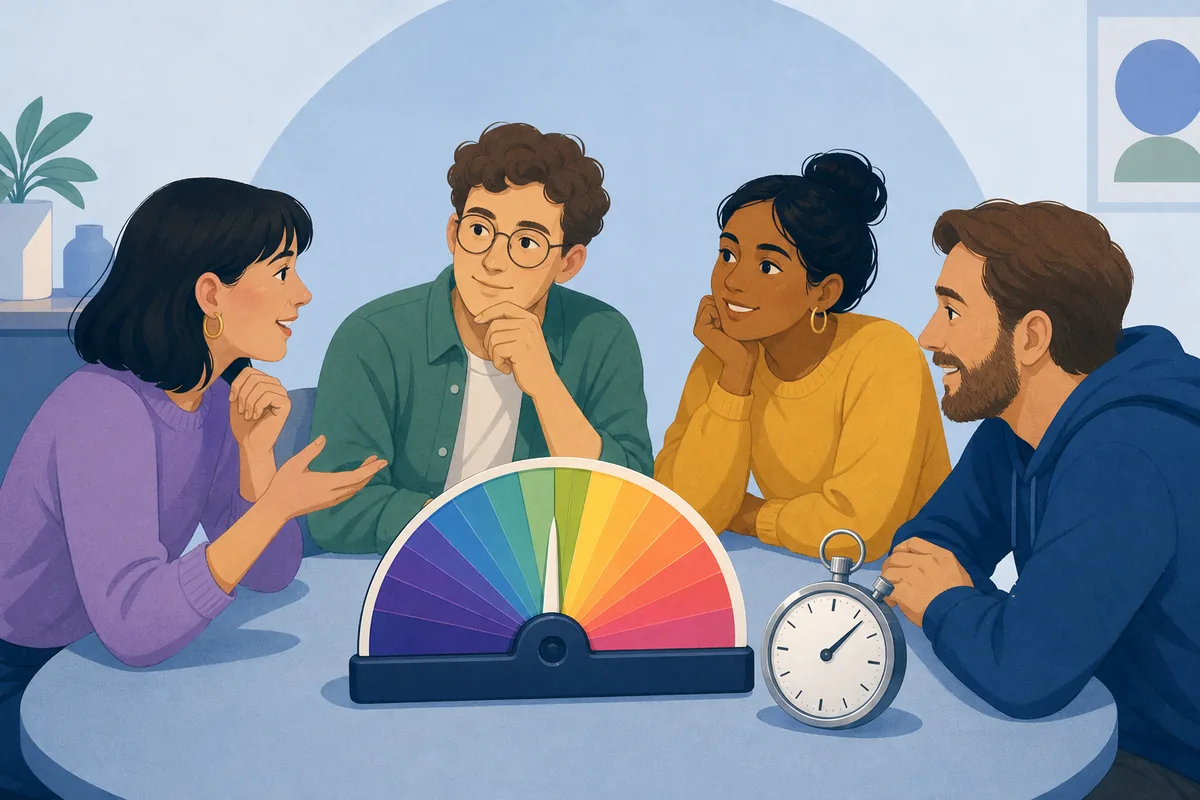
Editorial illustration of Wavelength players discussing a clue beside a spectrum dial and stopwatch
Most Wavelength timing comes from discussion, not from moving the dial. A timer keeps the debate fun without making the game feel rushed.

Wavelength Timing by Format

Quick online warmup: 10-15 minutes Play 4 to 6 rounds, skip long strategy talk, and use easy prompts from the browser game or the prompt list.
Standard party game: 25-35 minutes Use two teams, rotate the Psychic normally, and let each team discuss for roughly 60 to 90 seconds.
Full tabletop session: 30-45 minutes Best for groups that want the normal board-game feel, including setup, explanation, scoring, and several turns per team.
Large group or remote call: 40-60 minutes More voices mean longer clue debates. Use a host, a turn order, and a discussion cap to prevent slow rounds.
Source context: public board-game references such as the official CMYK Wavelength page, BoardGameGeek, and Meeple Mountain describe Wavelength as a 2-12 player party game with roughly 30-45 minutes of play. This guide adapts that baseline for browser play, screen sharing, and fixed-round hosting.

How Long Is One Round of Wavelength?

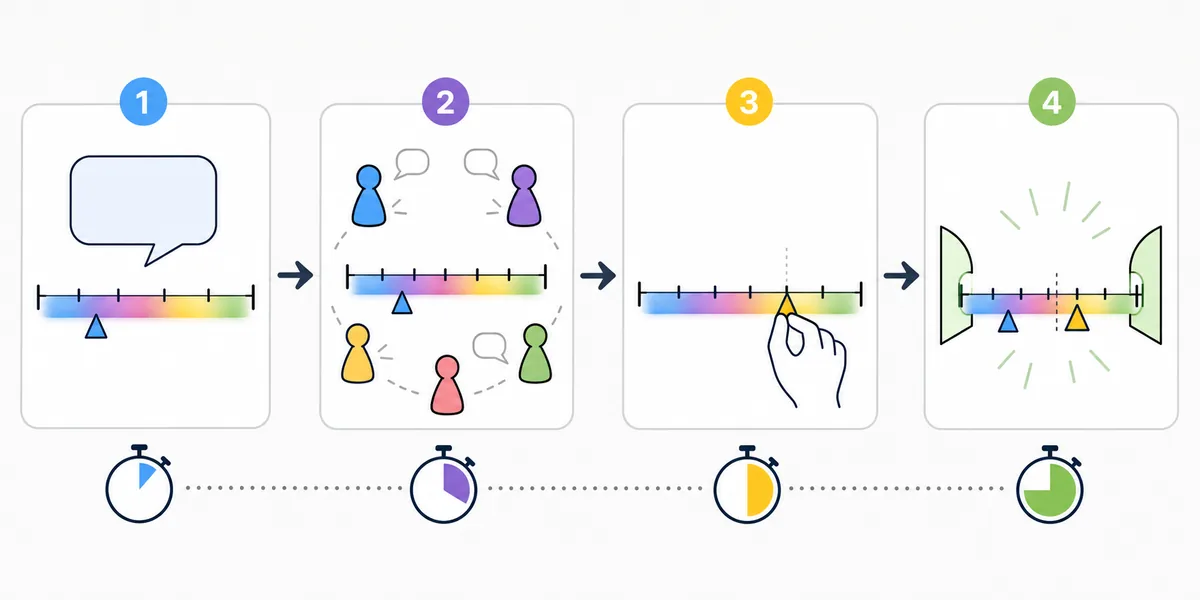
One Wavelength round usually takes 2 to 4 minutes. The Psychic looks at the hidden target, gives one clue, the team debates where the clue belongs on the spectrum, someone places the dial, and the host reveals the target. A fast group can finish a round in 90 seconds. A loud or analytical group can spend five minutes arguing about whether "lukewarm coffee" is more hot than cold.

The key is to decide the discussion limit before the first round. For casual friends, 90 seconds is enough. For a first game, two minutes feels more comfortable. For team-building or classroom play, shorter rounds often work better because the goal is participation, not perfect scoring.

Editorial four-step timing flow for a Wavelength round from clue to discussion, guess, and reveal
A single round is simple: clue, discussion, guess, reveal. The middle discussion step is where most extra time appears.
Round Step Typical Time What Slows It Down Host Fix
Psychic checks target 10-20 seconds New players forget who should look Say "everyone else look away" before revealing the target
Clue selection 20-45 seconds The Psychic searches for a perfect clue Allow one pass or use easier prompts
Team discussion 60-120 seconds Several players argue the same point Use a 90-second debate timer
Guess and reveal 20-40 seconds Players keep changing the final answer Ask one captain to lock the guess

How Group Size Changes the Game Length

Wavelength is flexible because players can form teams, but more people do not always mean a longer game. A group of eight can play quickly if each team has one final caller. A group of four can take forever if every clue turns into a debate. The practical rule is simple: as the player count grows, keep the number of teams low and make the host more active.

Group Best Format Expected Length Timing Advice
2 players Co-op or practice mode 10-20 minutes Use the single player guide style: take turns giving clues and focus on calibration.
4 players 2v2 teams 20-30 minutes Use the Wavelength 4 players setup and rotate roles every round.
6-8 players Two or three teams 25-40 minutes Give every team a final caller so debate does not stall the dial.
10-12+ players Two large teams 35-60 minutes Use safe prompts, shorter debate windows, and a fixed number of rounds.
Remote group One host controls the board 25-50 minutes Screen share the board, keep voice chat open, and avoid letting several people control the browser.

Best Time Limits for Online Wavelength

Online Wavelength is easier to schedule than the physical game because setup is almost instant. Open the board, choose teams, and start. The tradeoff is that remote discussion can drift unless the host gives the group a rhythm. For a voice call, use one of these plans:

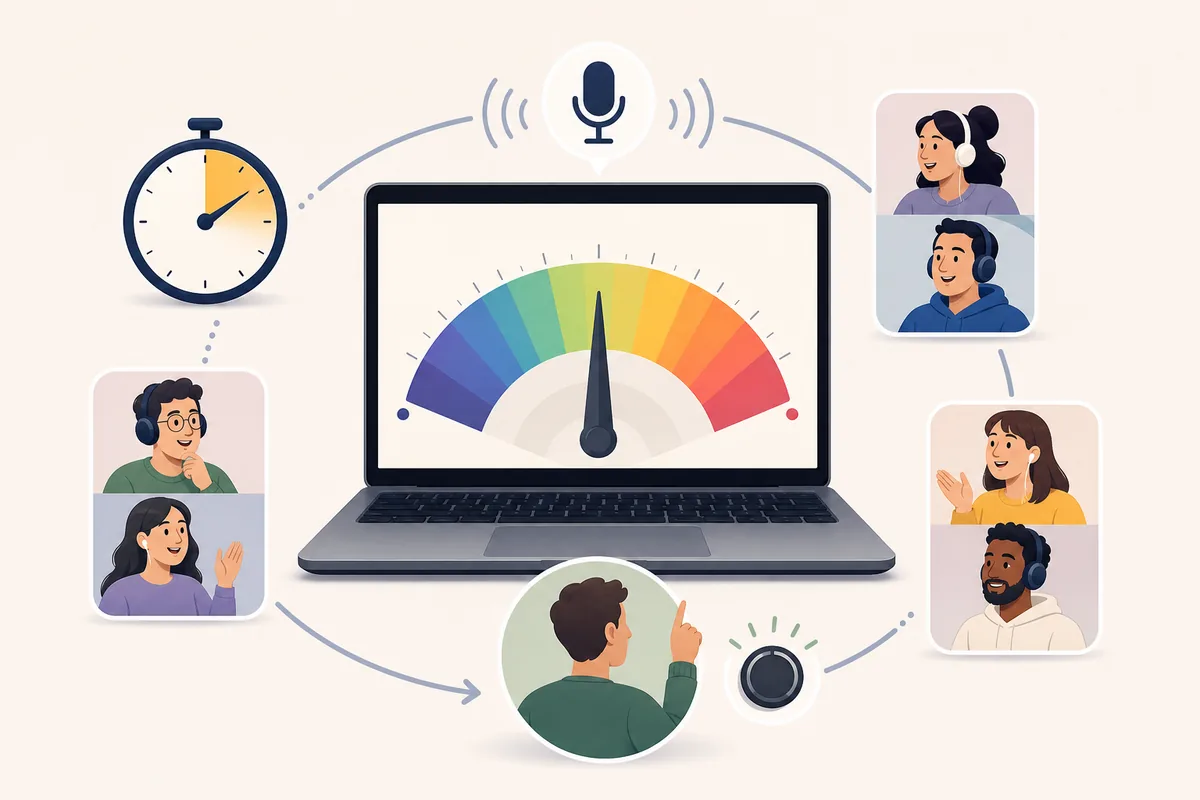
Editorial graphic showing an online Wavelength host managing a remote group with a timer and shared spectrum board
For remote games, the host should control the board, announce the debate window, and lock guesses before the discussion loops.
Host rule that saves the most time: ask the Psychic to give one clue, then stay quiet until the reveal. If the Psychic starts explaining during the debate, the round slows down and the clue becomes less fair.

Should You Play to Score or to Time?

If your group owns the physical board game and wants a full competitive session, play to the normal score target. If you are hosting a work meeting, classroom, Discord event, or family gathering with a fixed schedule, play to time. A fixed-time game keeps the energy high because players know the game will not overrun the agenda.

For a short event, announce the plan as "we will play six rounds" or "we will play until 8:25." That removes pressure from the scoring system and makes it easier to include late joiners. For a serious game night, use full scoring because the tension of close guesses is part of what makes Wavelength satisfying.

Goal Use Score Target Use Fixed Time
Competitive board-game night Yes, it preserves the original tension Only if another game starts soon
Remote team icebreaker Not needed Best choice: 10-20 minutes
Classroom activity Optional Best choice: stop before discussion fades
Large party Works if people stay seated Better if players drift in and out

How to Make Wavelength Faster Without Killing the Fun

Do not rush the Psychic too much. The clue is the whole game. Instead, reduce the parts that repeat or create confusion. Start with easier Wavelength prompts, choose one final caller per team, and cap debate before people restate the same arguments.

Use familiar categories first
Food, movies, weather, animals, and everyday habits create quick clues. Abstract prompts work better after the group warms up.
Set a debate window
A 90-second timer keeps the team focused while still allowing disagreement, which is the fun part of Wavelength.
Pick one final caller
Everyone can discuss, but one person locks the dial. This prevents a last-second loop of tiny adjustments.
Use numbers mode for speed
If the shared dial is hard to see, try the Wavelength online with numbers format for a faster 1-10 version.

FAQ

How long is a game of Wavelength?
Most games take about 30 minutes. A full tabletop session often lands around 30 to 45 minutes, while a short online warmup can be 10 to 20 minutes.
How long is one Wavelength round?
One round usually takes 2 to 4 minutes, depending on clue selection and team discussion. New groups and large groups often need longer.
Can Wavelength be played in 10 minutes?
Yes, if you play a fixed number of quick rounds instead of a full score race. Use easy prompts, a 60-second discussion limit, and two teams.
Does Wavelength take longer with more players?
Usually yes, but only because discussion takes longer. Keep two large teams, choose one final caller per team, and cap debate to control the schedule.
Is online Wavelength faster than the board game?
It can be faster because there is no physical setup, but remote voice chat can add time. A host, timer, and fixed round count make online games predictable.
What is the best Wavelength length for a work icebreaker?
Plan 10 to 20 minutes. Play four to eight rounds, use work-safe prompts, and stop at the scheduled time even if the score is close.

Related Wavelength Pages