Wavelength Online With Strangers

Run public Wavelength rounds safely on Discord, Zoom, Reddit, classrooms, or community game nights.

Public Game Setup Discord Friendly Safe Prompts Host Scripts
Fast answer: yes, you can play Wavelength online with strangers, but it works best when one host controls the board, players join through a voice or video room, and the group uses work-safe prompts with clear moderation rules. Avoid random unmoderated screen-sharing rooms; use a Discord server, classroom call, club event, or community game night where the host can remove disruptive players.

Can You Play Wavelength Online With Strangers?

Wavelength online with strangers is possible because the game does not require private cards, hidden hands, or synchronized apps for every player. One person can open the browser game, share the screen, and let the group discuss where the clue belongs on the spectrum. The tricky part is not the technology. The tricky part is keeping a public group fair, comfortable, and spoiler-free.

The best format is a hosted public room. The host opens Wavelength Game Online, explains the role of the Psychic, and manages the hidden target phase. Everyone else joins on Discord, Zoom, Google Meet, a classroom projector, or a community voice room. New players can learn the full rules on the How to Play Wavelength guide, but a public game should use a shorter spoken explanation so strangers can start quickly.

This page is intentionally different from the general prompts page. If you only need a giant list of spectrum pairs, use the 200+ Wavelength prompts collection. If you want a complete random round, use the Wavelength game generator. This guide focuses on the public-play problem: where to find strangers, how to host them, which prompts are safe, and what rules prevent awkward rounds.
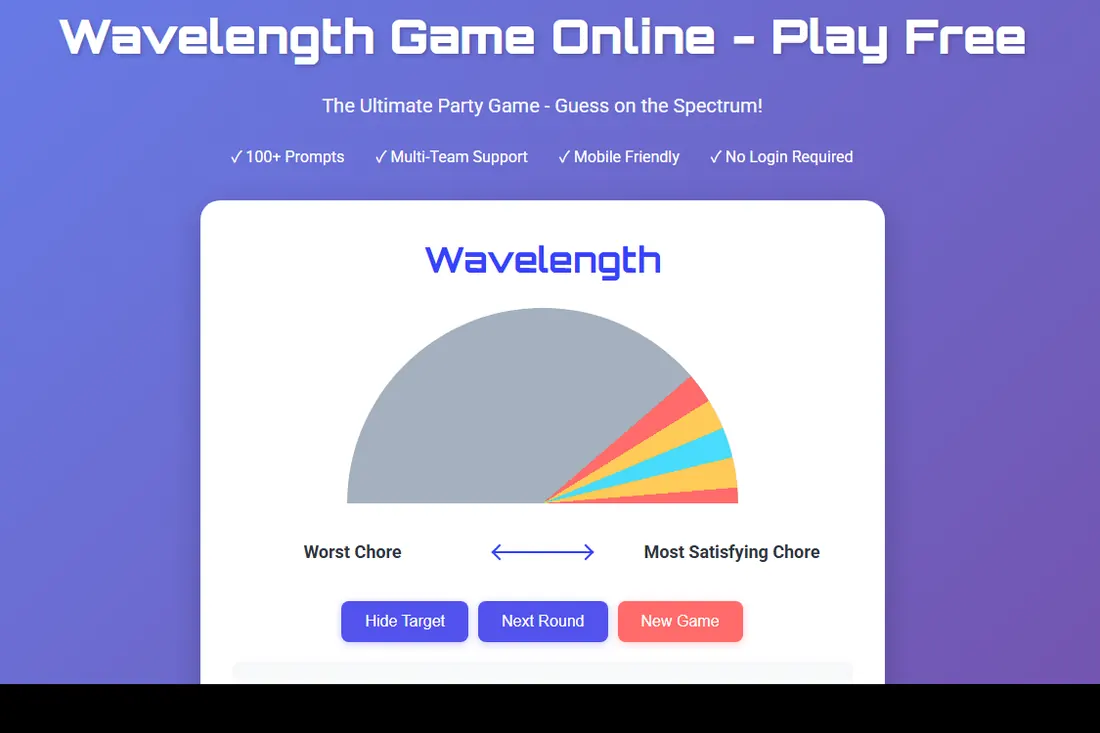
Wavelength online game board prepared for a hosted public game with strangers
A public Wavelength game works best when one host controls the board and the rest of the group joins through a moderated voice or video room.

Best Places to Find Players

Wavelength is a social guessing game, so the quality of the room matters more than the size of the room. A small moderated group of six strangers usually feels better than a chaotic public lobby with twenty people talking over each other. Use spaces where people already expect party games or conversation games.

Discord Game Servers
Best for scheduled public rounds. Create a voice channel, pin the rules, and let the host share the Wavelength board.
Board Game Communities
Good for players who already understand turn-taking. Post the start time, player cap, and expected round length.
Classroom or Club Calls
Useful for icebreakers because the host can choose safe prompts and keep discussion respectful.
Remote Team Mixers
Works for coworkers who do not know each other well. Use work-safe prompts and shorter rounds.
Reddit or Event Posts
Good for recruiting, but move the actual game into a moderated voice room before play starts.
Friend-of-Friend Nights
The safest stranger format. People are new to each other, but the social graph still discourages trolling.

6-Step Setup for Public Wavelength

1
Choose a Hosted Room
Use Discord, Zoom, Meet, or a club call where one host can mute, remove, or redirect players if needed.
2
Open the Board
The host opens the online game and shares the screen. Do not give every stranger control of the board.
3
Cap the Group
Start with 4-10 players. More than 12 strangers usually creates slow turns and overlapping voices.
4
Explain Spoiler Rules
Only the Psychic sees the target. Everyone else looks away or the host pauses the share while the target is visible.
5
Use Safe Prompts
Begin with food, movies, habits, weather, or everyday opinions before using personal or controversial topics.
6
Rotate Quickly
Give each Psychic one clue, set a 60-90 second discussion limit, score the round, and move on.

Public Room Formats Compared

Different stranger groups need different rules. Use this table before you invite people, because the wrong format can make Wavelength feel either too quiet or too messy.

Format Best For Setup Risk to Manage
Discord Voice Room Public game nights and recurring groups Host shares screen, players discuss in one channel People talking over each other
Zoom or Meet Call Classes, clubs, remote teams Host shares browser, uses mute controls when needed Accidental target spoilers during screen share
Forum-Recruited Group Finding new players from Reddit or community posts Recruit publicly, then move into a moderated room Unknown player behavior
Drop-In Stream Audience participation with a streamer or host Chat suggests guesses while the host controls the needle Slow chat and low signal answers
Phone-Only Group Casual mobile players Use the 1-10 numbers version if the dial is hard to see Small screens and missed visual details

Host Script for Strangers

A clear host script prevents most public-game problems. Read something like this before the first round:

"We are playing Wavelength. Each round has two opposite ideas on a spectrum. One person, the Psychic, will briefly see the hidden target and give exactly one clue. Everyone else discusses where that clue belongs. Please do not talk while the Psychic is looking at the target. Keep clues and jokes safe for a mixed public room. If a prompt feels uncomfortable, say pass and we will switch it."

That script does three useful things. It teaches the rules in under a minute, makes the hidden-information rule explicit, and gives players permission to skip prompts that feel too personal. Strangers are more willing to participate when they know the host has a plan.

Safe Prompts for Strangers

Public Wavelength prompts should be easy to understand, low pressure, and not built around private identity details. Avoid prompts that invite players to rank each other's appearance, politics, religion, trauma, dating history, salary, or medical experiences. Those topics can work among close friends only when everyone consents, but they are poor defaults for strangers.

Safe Choice to Risky Choice
Works well because players can use everyday examples without revealing personal details.
Boring Snack to Perfect Snack
Food prompts are low stakes, familiar, and good for warmups with mixed groups.
Quiet Place to Loud Place
Easy for new players because everyone can imagine a library, cafe, concert, or stadium.
Low Effort to High Effort
Strong for school, work, and hobby groups because it creates debate without being invasive.
Normal Pet to Weird Pet
Playful and concrete, with plenty of middle-ground examples.
Forgotten Trend to Iconic Trend
Useful for pop-culture rooms, but only if the group shares enough references.

For a longer deck, choose from the easy, food, movies, animals, work, and pop-culture sections in the Wavelength prompts list. If your group is public, start safer than you think you need to. You can always increase weirdness after the room proves it can handle the tone.

Moderation Rules That Keep It Fun

Moderation for Wavelength does not need to feel heavy. The host simply needs enough structure to protect the discussion phase. Public rooms fail when people spoil the target, argue about the rules, use personal insults as clues, or derail every spectrum into a debate that no longer helps the guess.

  • One host controls the board. Do not rotate browser control among strangers unless the group is trusted.
  • One Psychic speaks first. The Psychic gives one clue, then stays quiet until scoring.
  • No personal attack clues. A clue should point to the spectrum, not embarrass a player in the room.
  • Use a pass rule. Any player can ask to skip a prompt without explaining why.
  • Time-box discussion. Public rounds usually need 60-90 seconds, not a five-minute argument.
  • Remove repeat spoilers. A player who keeps revealing the target or ignoring boundaries should leave the round.

For official context, Wavelength is widely described as a social party game built around a Psychic giving a clue and the team guessing a hidden target. The CMYK Wavelength product page and the BoardGameGeek Wavelength listing are useful references if your public group wants to understand the original tabletop format.

What to Do When Strangers Join Late

Late joiners are common in public game rooms. Do not restart the whole game unless the group is very small. Instead, let the new player watch one round, then add them to the next guessing team or make them the next Psychic after they understand the rule. Watching one full round teaches Wavelength faster than a long explanation.

If too many people join, split into two rooms. One host can run the main board while another trusted player starts a second room with the same prompts. If you cannot split, switch to a cooperative format where the room tries to reach a shared score over five rounds. This lowers pressure and makes it easier for quiet players to contribute one sentence instead of competing for control.

For smaller groups that keep losing players, use the Wavelength 4 players setup or the single player practice guide as fallback formats. A public event does not need to end just because the room size changes.

Common Problems and Fixes

Problem Likely Cause Fix
Players keep spoiling the target Screen share stays visible while the Psychic looks Pause sharing, ask non-Psychics to look away, or move the Psychic to a private host message.
Discussion gets chaotic Too many players speak at once Use a 60-second timer and ask each player for one sentence before open debate.
Prompts feel awkward The room does not know each other well enough Switch to food, everyday objects, movies, weather, or work-safe topics.
Mobile players cannot see the dial Small screen or low-resolution stream Use the numbers mode or have the host describe approximate positions aloud.
One person dominates every guess No turn structure Rotate who makes the final call, even if the whole group discusses first.

FAQ

Is there a built-in Wavelength public lobby? +
No. This site lets you play Wavelength in the browser, but it does not provide a matchmaking lobby. Use Discord, Zoom, a classroom call, a club event, or a moderated community room to find players.
Is it safe to play Wavelength with random people online? +
It can be safe when the room is moderated, the host controls the board, and prompts avoid personal or sensitive topics. Avoid unmoderated rooms where strangers can disrupt the game or pressure players.
How many strangers should join one Wavelength room? +
Four to ten players is the best range. Below four, the discussion may feel thin. Above twelve, public rounds often become slow unless the host uses strict turn-taking.
What prompts should I avoid with strangers? +
Avoid prompts about appearance, politics, religion, salary, medical details, trauma, dating history, or anything that asks players to judge each other personally. Use light shared topics first.
Can strangers play Wavelength without voice chat? +
Yes, but it is slower. Text chat works for short clues and guesses, while voice chat is better for the debate phase that makes Wavelength fun.
What is the easiest version for phone-only public groups? +
Use the Wavelength online with numbers format. A 1-10 hidden target is easier to describe in voice chat and easier for phone users to follow than a shared dial.

Quick Start Checklist

If you are hosting tonight, keep the plan simple: invite 4-10 people, open the browser game, share your screen, read the host script, start with safe prompts, and play five warmup rounds before choosing stranger or deeper categories. Link new players to the rules guide after the session rather than making everyone read a long page before the first clue.

When the group is comfortable, branch out. Use the round generator for fresh categories, the custom prompts guide for themed events, or the prompt list when you need a large public-safe deck.