Wavelength Game Online Single Player

Use 1-team mode to practice clues, scoring, and spectrum thinking on your own.

1 Player Practice 1-Team Setup No Download Free in Browser

Wavelength

Single Player Setup

Quick Start: Set teams to 1, peek at the target, create a clue, hide the target, then guess where your own clue should land.

Can You Play Wavelength Online Single Player?

Yes. Wavelength is best known as a group party game, but you can play wavelength game online single player by using the 1-team setup above. The solo version is not the same experience as a noisy game night, because there is no team debate, but it is useful for practicing clue quality, learning how the scoring zones feel, and warming up before playing with friends.

The key difference is the role split. In a normal round, one person is the Psychic and the rest of the team guesses. In single player Wavelength, you temporarily play both roles. First you act as the Psychic: look at the hidden target and choose a clue that represents that exact place on the spectrum. Then you hide the target, pause long enough to reset your memory a little, and act as the guesser by placing the needle where that clue seems to belong.

This page is intentionally focused on solo and 1-player use. If you want the full group rules, read the How to Play Wavelength guide. If you want a large list of topics, use the Wavelength prompts list. If you want to design your own spectra, the custom prompts page is the better place to start.
How to Use 1-Team Mode for Solo Practice

The fastest way to play wavelength online 1 player is to set the team count to 1 and treat each round as a practice drill. You are not trying to beat another team. You are trying to measure whether a clue naturally points to the same place on the spectrum after the target is hidden.

1
Choose 1 Team
Set the number of teams to 1. Name the team anything simple, such as Solo, Practice, or Warmup.
2
Read the Spectrum
Look at the two ends carefully. Ask what the middle would mean before thinking about extreme examples.
3
Create One Clue
Peek at the target and write one clue that feels like the same percentage between the two ends.
4
Hide and Guess
Hide the target, wait 5-10 seconds, then place the needle based only on the clue you created.
5
Score the Round
Reveal the target and note whether the clue was too weak, too extreme, or about right.
6
Adjust Next Time
After 5 rounds, look for patterns. Most solo mistakes come from using clues that are too obvious or too broad.

Solo Wavelength Practice Setup

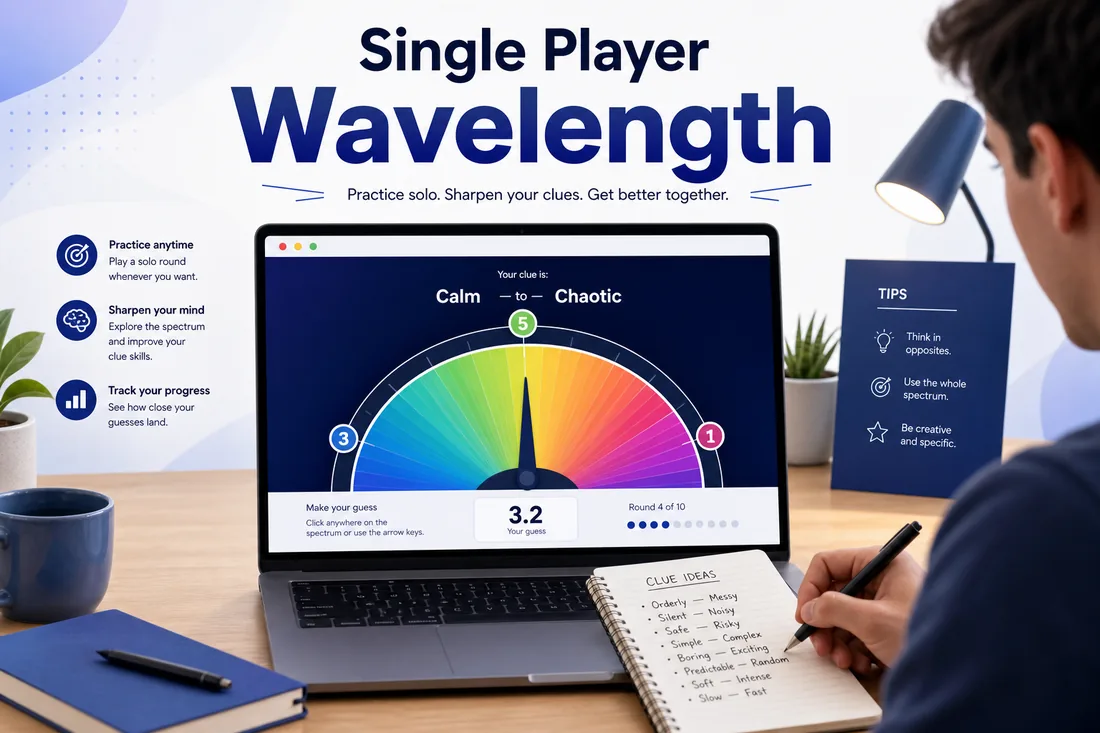
A good single player session is short and deliberate. Ten focused rounds are usually better than thirty casual rounds, because the value comes from reviewing why each clue worked or failed. The image below shows the practical setup: one browser game, one player, one clue note, and a clear scoring target.

Solo Wavelength practice setup with one player using a browser dial and clue notes
A solo Wavelength session works best when you write down each clue and review the score after every reveal.

For example, imagine the spectrum is Cold to Hot and the hidden target is around 70% toward Hot. A weak clue might be "drink" because it could land almost anywhere. A stronger solo practice clue might be "fresh coffee after two minutes." It is specific, it suggests warmth, and it avoids the extreme heat of boiling water. After you reveal the target, you can judge whether the clue naturally landed near 70% or drifted too far toward the center.

3 Single Player Variations

Clue Calibration
Play 10 rounds and write one clue before hiding the target. Your goal is not a perfect score; it is learning which clues feel like 25%, 50%, 75%, and 90% on different spectra.
Delayed Guess Mode
After creating the clue, wait 30 seconds before guessing. This makes the round less memory-based and closer to how another player might interpret the clue.
Prompt Testing
Use solo mode to test custom spectrum ideas. If you cannot imagine examples near the middle and both edges, the prompt probably needs clearer opposites.

Single Player vs 2 Player vs Party Mode

Single player Wavelength is best understood as practice, not a full replacement for the social game. The table below shows when each format makes sense.

For context, the original Wavelength board game is built around a social team format. The official CMYK Wavelength page and the BoardGameGeek listing both frame Wavelength as a party game about teams trying to read each other's thinking. That is why this solo page is positioned as a practice and warmup guide, not as a replacement for the full group experience.

Mode Best For Strength Limitation
Single Player Practice, warmups, testing prompts Fast and focused No real team discussion
2 Player Couples, close friends, quick calls Clear back-and-forth Less debate than a group
Party Mode Game nights, classrooms, remote teams Best social energy Needs more people

If someone searches for wavelength game online with bot, they are usually looking for a way to play without coordinating a group. This page solves part of that problem with solo practice, but it should be clear: the current browser game does not provide an AI opponent or automatic bot teammate. For now, 1-team mode is the honest way to play alone.

Best Prompts for Solo Practice

The best solo prompts have a clear gradient and enough everyday examples that you can judge your own clue fairly. Avoid prompts that only work because a specific friend group has an inside joke. Save those for multiplayer.

Solo Prompt Quality Checklist

Before using a prompt in solo practice, test it with three anchor examples: one near the left end, one near the middle, and one near the right end. If all three examples are easy to explain, the prompt is likely strong enough for single player practice and group play. If the middle feels empty, rewrite the endpoints before playing.

Cold to Hot
Practice with clues like room-temperature tea, fresh coffee, a sauna bench, or a freezer handle.
Boring to Exciting
Good for learning intensity. A museum plaque, a playoff game, and a surprise party all land in different places.
Cheap to Expensive
Easy to visualize, but still subjective. A lunch special, concert ticket, and wedding venue create useful anchors.
Normal to Weird
Great for solo calibration because the middle is debatable. Try clues that are unusual without being absurd.

For more examples, use the full Wavelength prompts collection. For solo practice, choose prompts that let you explain your reasoning in one sentence after each reveal. If you cannot explain why a clue belongs at a certain point, the clue probably was not calibrated enough.

When Solo Wavelength Works Best

Solo Wavelength is most useful before a real game. It helps a new Psychic understand that "good clue" does not mean "clever clue." A good clue creates a reliable location on the spectrum. Sometimes the plain clue is better than the funny clue because other players can place it more accurately.

It also works well for teachers, facilitators, and team leads who want to preview prompts before using them with a group. A prompt that feels easy alone may still create debate in a team, but solo testing quickly catches weak spectra such as two ends that are not true opposites, prompts with no meaningful middle, or topics that require niche knowledge.

The limitation is important: Wavelength becomes more memorable when people disagree. Single player mode can teach mechanics and improve clue judgment, but the full experience still comes from hearing how other people interpret the same clue differently. Use solo mode as a practice room, then play the online game with friends when you want the real party-game energy.

Wavelength Single Player FAQ

Can I play Wavelength game online single player?
Yes. Set the game to 1 team and use it as a solo practice mode. You will play both the Psychic role and the guesser role, so it is best for practice rather than competitive play.
Is there a Wavelength online solo mode with a bot?
Not on this site right now. You can play solo through 1-team mode, but there is no AI bot teammate or automatic opponent. The best workaround is to use delayed guess mode so your clue feels less memory-based.
What is the best way to practice Wavelength alone?
Play 5-10 short rounds. For each round, write one clue, hide the target, guess, reveal, and note whether the clue was too central or too extreme. This improves clue calibration faster than simply playing many rounds.
Is single player Wavelength as fun as multiplayer?
It is useful, but different. Solo play is better for learning and testing prompts. Multiplayer is better for discussion, surprises, and the social tension that makes Wavelength memorable.
Can I use custom prompts in solo practice?
Yes. Solo practice is a good way to test whether a custom prompt has a clear gradient. If you can imagine examples near both ends and the middle, the prompt is more likely to work in a real game.

Ready to Practice Wavelength Solo?

Start Single Player Mode Play Full Online Game