Wavelength 4 Players
Setup

Use a clean 2v2 format, rotate the Psychic role fairly, and keep every round moving.

2v2 Teams Co-op Option Remote Friendly 10-Round Plan

Can You Play Wavelength With 4 Players?

Yes. Wavelength 4 players works very well when you set up two teams of two. One player on the active team becomes the Psychic, gives one clue, and their teammate places the needle after thinking out loud. Then the other pair takes a turn. With only four people, everyone gets enough time to talk, but the game still has the core team-reading tension that makes Wavelength fun.

The best default format is 2v2 competitive play. It keeps the table balanced, gives each player a partner to discuss with, and prevents one confident person from controlling every guess. If your group wants a calmer night, you can also play four-player co-op: all four players try to reach a shared score target over 8-10 rounds.

This page is intentionally about the four-player setup. For the complete rules, scoring zones, and general strategy, use the How to Play Wavelength guide. If you only have one person, use the single player Wavelength guide. If you need more spectra for your four-player game, open the Wavelength prompts list.
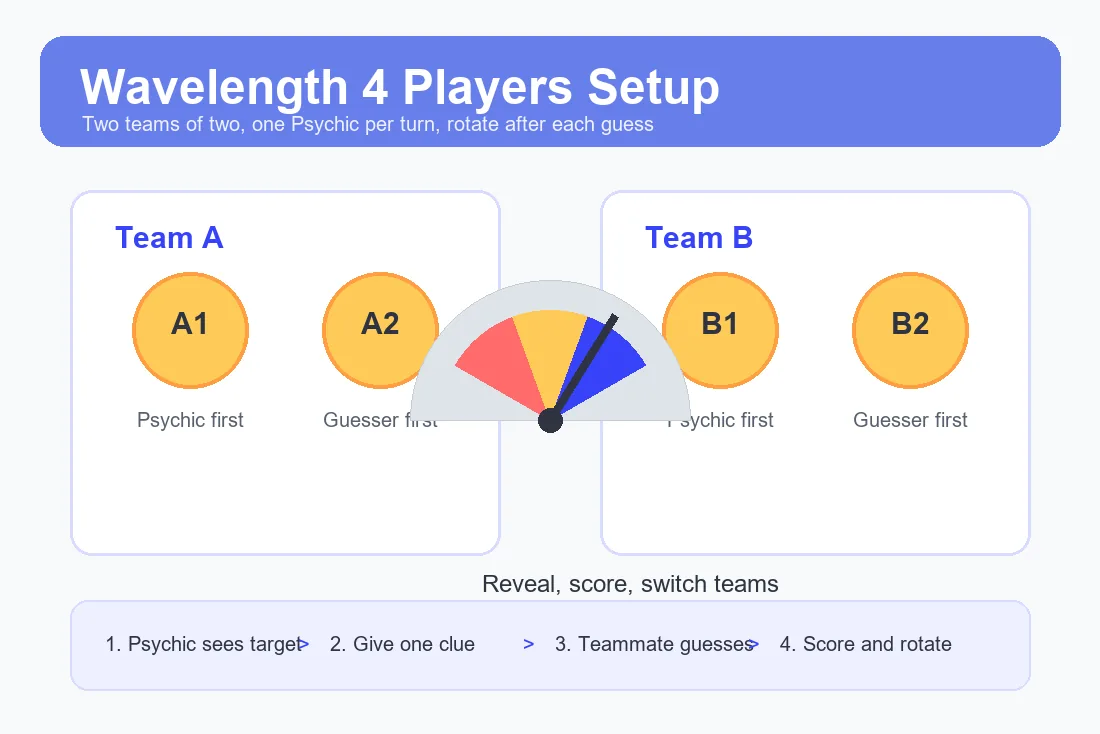
Wavelength four player setup with two teams of two and a rotating Psychic role
The easiest four-player setup is two teams of two, with the Psychic role rotating after each turn.

Best Wavelength Game 4 Players Setup

1
Make Two Teams
Split into Team A and Team B with two players each. Pair people who do not always think the same way for better discussion.
2
Pick a Psychic
On the active team, one player sees the target and gives a clue. Their teammate guesses where it lands.
3
Discuss Out Loud
The guesser should explain their reasoning. The Psychic stays quiet after giving the clue.
4
Score and Switch
Reveal the target, score the round, then the other team plays. Rotate Psychics every team turn.
5
Play 8-10 Rounds
A 10-round game gives each player multiple clue-giving turns without dragging the session.
6
Use a Tie Breaker
If scores tie, play one final sudden-death round where the closest team wins.

2v2 Rules and Role Rotation

For four players, the most important rule is role rotation. If Player 1 is the Psychic for Team A's first turn, Player 2 should be the Psychic for Team A's next turn. Team B does the same. This keeps the game fair and lets everyone practice both clue-giving and interpretation.

A simple turn order looks like this: Team A Player 1 gives a clue, Team B Player 3 gives a clue, Team A Player 2 gives a clue, Team B Player 4 gives a clue, then repeat. The teammate who is not Psychic is the main guesser, but the opposing team can listen and laugh without helping.

Four-player Wavelength works best when the Psychic gives exactly one clue and then stops talking. No extra hints, no facial expressions meant to correct the guess, and no "you are close" comments. With only one teammate guessing, even small reactions can give away too much.

Format Best For How It Works Watch Out For
2v2 Teams Most game nights One Psychic, one teammate guessing, then switch teams Psychic reactions after the clue
Co-op 4 Players Casual groups, families, warmups Everyone tries to beat a shared score target Too much group consensus can make clues easy
Remote 2v2 Video calls One host shares the game screen and hides the target after the Psychic peeks Screen sharing mistakes during the hidden target phase

Recommended Scoring for 4 Players

The standard scoring works for four players: 5 points for the center, 3 for close, 1 for near, and 0 for a miss. Because each team has only one guesser, the game can swing quickly. A team that hits one bull's eye can take a big lead, so 8-10 rounds usually feels better than a very short game.

For a 20-minute session, play 10 total team turns: five turns for Team A and five for Team B. That gives each player two or three Psychic turns depending on the starting order. For a quick 10-minute warmup, play six total team turns and accept that the result will be more casual.

If your group includes new players, start with easier prompts for the first two turns. Clear spectra such as Cold to Hot, Cheap to Expensive, or Boring to Exciting help players understand how far a clue should move along the line. Save strange or inside-joke prompts for later rounds.

Best Prompts for Four-Player Wavelength

Four-player games need prompts that create discussion without needing a huge crowd. Avoid prompts where only one person knows the reference. The best prompts are everyday, flexible, and easy for two people to debate from different angles.

Safe Choice to Risky Choice
Good for couples, friends, and work groups because people disagree about what counts as risky.
Normal Thing to Own to Weird Thing to Own
Works well with four people because each clue sparks quick examples without needing deep rules knowledge.
Bad Movie to Great Movie
Best when all four players know the movie. If not, switch to a broader entertainment prompt.
Not Funny to Hilarious
Strong for small groups because humor taste differs, which makes the guesser explain their placement.
Low Energy to High Energy
Easy for remote calls and quick team games because the scale is intuitive.
Overrated to Underrated
Good later in the game after players understand that the middle should still be debatable.

For a larger deck, use the 200+ Wavelength prompts collection. If you want prompts built around your friend group, the custom prompts guide explains how to write spectrum pairs with a clear middle.

Remote Wavelength With 4 Players

Four-player Wavelength is one of the easiest remote formats because only one person needs to manage the board. Put the online game on a shared screen, split into two voice-chat teams, and have the Psychic briefly view the target while the other players look away or the host pauses screen sharing.

For remote play, keep teams stable for the full game. Switching partners every round can be fun in person, but it creates confusion on a call. Use clear verbal markers: "Team A is guessing now," "Psychic has seen the target," and "Target is hidden." These simple announcements prevent accidental spoilers.

If screen sharing feels clumsy, use the Wavelength online with numbers tool for a faster 1-10 version. It is less visual than the dial, but it is easier when everyone is on a phone or when the group has limited time.

Common 4-Player Mistakes

Letting the Psychic coach the guess. In a two-person team, it is tempting for the Psychic to react while their teammate moves the needle. Treat the Psychic as silent after the clue. That keeps the round fair and makes the final reveal more satisfying.

Using prompts that require group history. A four-person game can handle inside jokes, but only if all four players understand them. If one team lacks the context, the round becomes uneven. Use shared everyday topics for competitive games and save niche prompts for co-op.

Playing too few rounds. Four-player games can feel random if each person only gives one clue. Play enough turns for both teams to recover from a bad clue. Eight or ten rounds is the sweet spot for most small groups.

Over-discussing every clue. With only one guesser per team, there is no need for a five-minute debate. Give the guesser 30-60 seconds to talk through their reasoning, place the needle, and reveal.

Wavelength 4 Players FAQ

Is Wavelength good with 4 players?
Yes. Four players is a strong small-group size when you use two teams of two. Each player gets enough turns, and every clue still has real team interpretation.
What is the best Wavelength 4 players setup?
The best default setup is 2v2. One player is the Psychic, one teammate guesses, then the other team takes a turn. Rotate the Psychic role every team turn.
Can 4 people play Wavelength cooperatively?
Yes. Set a shared goal, such as 25 points in 10 rounds, and have the group work together. Co-op is better for casual or family play than for competitive scoring.
How many rounds should a 4-player game use?
Use 8-10 rounds for a normal session. That gives every player multiple turns as Psychic and reduces the impact of one unlucky clue.
Can you play Wavelength with 4 players online?
Yes. One player can host the online board and share the screen. Keep the Psychic peek private, hide the target before discussion, then reveal after the guess.

Ready for a 4-Player Round?

Create two teams of two, rotate the Psychic role, and start with a simple spectrum.