9 Games Like Wavelength for Every Kind of Group

The best alternatives depend on what your group actually loves: subjective clues, mind-reading, word association, cooperative problem-solving, or loud team debate.

9 Compared GamesGroup-Fit GuideQuick Verdicts
Quick answer: Just One is the easiest cooperative substitute, Codenames is the strongest team word game, Dixit best preserves subjective interpretation, and Decrypto is the best step up for groups that want sharper deduction. None is a perfect copy of Wavelength because the spectrum dial creates a unique kind of argument. Choose the alternative that keeps your favorite social behavior rather than the one with the most similar box description.
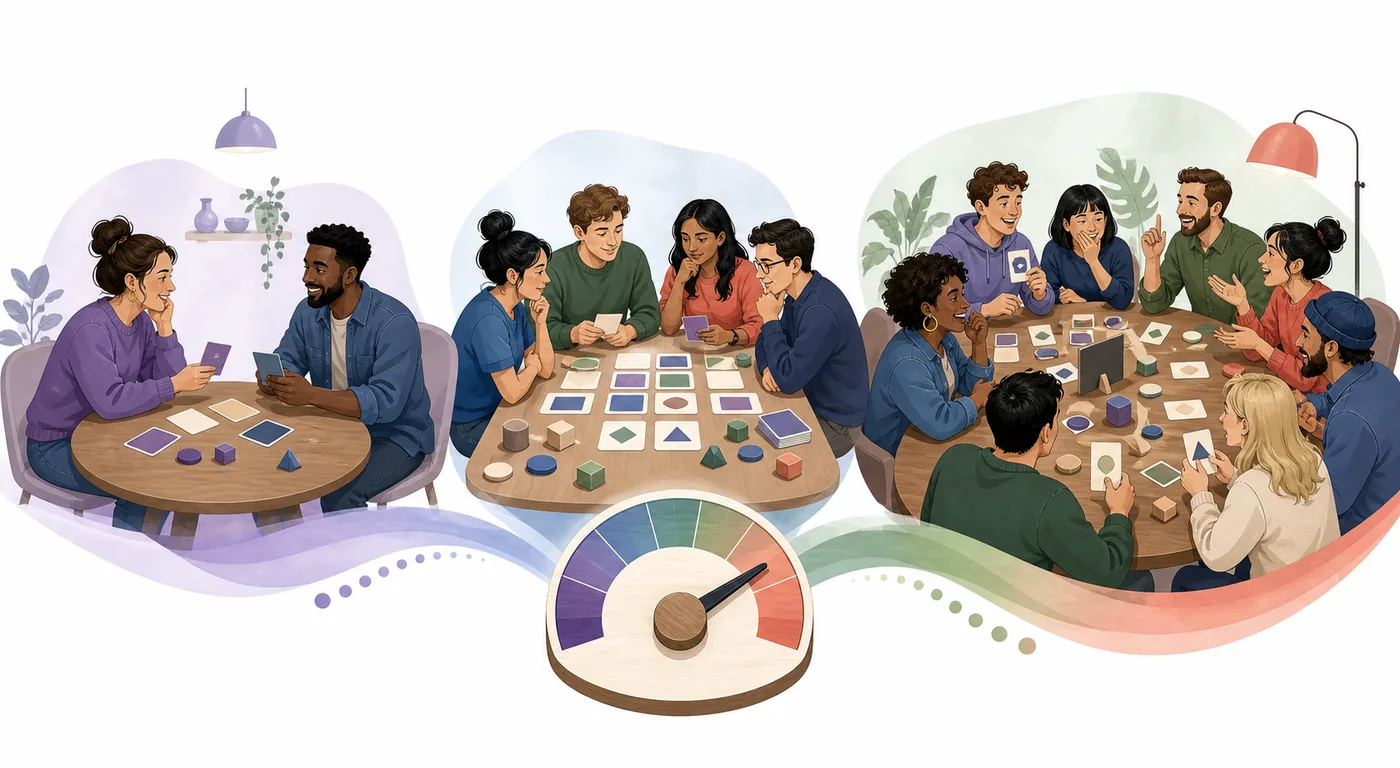
Editorial illustration of friends comparing several conversation and clue-giving party games
Editorial illustration of the decision behind this guide: choose a social game by the kind of conversation it creates. It is not an official game screenshot.

People searching for games like Wavelength are usually not asking for another plastic dial. They want the moment when one clue reveals how differently their friends think. A useful alternative therefore needs at least one of four qualities: a clue that supports multiple interpretations, a reason to discuss those interpretations, a team or cooperative goal, and enough variation that the same group can play again without repeating the same conversation.

This guide separates genuinely similar social mechanisms from broad “party game” recommendations. If you have not played the original yet, try the free online Wavelength board or read the Wavelength rules guide first. If you are deciding whether to buy the physical edition, our Wavelength board game review covers that narrower question.

GameClosest Wavelength qualityMain differenceBest for
Just OneReading how teammates will interpret cluesFully cooperative and much more conciseMixed-experience groups that want an easy teach
CodenamesTeam discussion around one clueClues connect words rather than a position on a scaleCompetitive teams and repeat game nights
DixitSubjective interpretation and knowing the groupUses surreal pictures instead of opposite conceptsCreative, visual, and story-friendly players
DecryptoCalibrating clues for your teamAdds code interception and heavier deductionGroups ready for more strategy
So Clover!Finding shared associationsCooperative word links replace public debateSmall groups that enjoy calm puzzles
Herd MentalityPredicting what the room will thinkRewards the common answer rather than precisionLarge casual parties and families
Green Team WinsMatching the majority's judgmentFaster questions with less clue craftLoud groups that want immediate laughs
MonikersShared references and group-specific meaningPerformance and memory replace the spectrumOutgoing adult groups and recurring jokes
ConceptCommunicating an idea indirectlyUses icons and silent hints instead of spoken cluesPlayers who like visual logic and low-pressure play

The Best Games Similar to Wavelength, Explained

1. Just One: Best Easy Cooperative Pick

One player guesses a word while everyone else writes a one-word clue. Duplicate clues disappear, so the group must predict not only what the guesser understands but also what the other clue-givers will write. That double layer of mind-reading feels familiar to Wavelength players. Choose it when you want almost no setup, no teams, and a friendly shared score.

2. Codenames: Best Team Word Game

Codenames keeps the “one clue, many interpretations” tension but gives the clue-giver several target words to connect. Teammates debate which words belong together while avoiding dangerous guesses. It is less personal than Wavelength because the board constrains the answer, yet it produces equally memorable arguments and rewards clue calibration over trivia.

3. Dixit: Best for Subjective Thinkers

Dixit replaces the spectrum with dreamlike artwork. The storyteller gives a clue that should be neither too obvious nor too obscure, and everyone chooses an image that might fit. Scoring rewards a clue that some—but not all—players understand. That balance is remarkably close to placing a Wavelength clue at the right level for a particular audience.

4. Decrypto: Best Strategic Upgrade

Two teams create clues for secret numbered words while listening for patterns in the opposing team's language. Good clues must be clear enough for teammates and indirect enough to resist interception. Decrypto asks for more memory and deduction than Wavelength, so it works best after a group has outgrown lighter clue games but still wants conversation at the center.

5. So Clover!: Best Calm Word Puzzle

Players connect pairs of words with linking clues, then cooperate to reconstruct the original arrangement. The fun comes from discovering why one person believed a clue joined two ideas. It lacks the public spectrum debate, but it preserves the satisfying reveal of another person's mental path. It is especially good for four people or a quieter evening.

6. Herd Mentality: Best Crowd Mind-Reading

Instead of guessing one clue-giver's target, everyone tries to write the answer most other players will choose. The questions are broad enough to expose group assumptions, which creates the same “how could you possibly think that?” reaction as Wavelength. It is less precise and more chaotic, making it a dependable option for larger mixed-age groups.

7. Green Team Wins: Best Fast Party Energy

Players answer opinion and estimation questions, then score by joining the majority. The game moves faster than Wavelength and gives less room for a carefully built clue, but it delivers repeated social alignment moments. Pick it for a crowd that wants quick reveals, easy drop-in play, and more cheering than analysis.

8. Monikers: Best for Inside Jokes

The same set of names and concepts returns across rounds with tighter clue restrictions, so the table gradually develops shared shorthand. Wavelength fans who love callbacks and learning how friends communicate often enjoy that evolving group language. Monikers is more performative and can be louder, so reserve it for players comfortable acting, describing, and being watched.

9. Concept: Best Nonverbal Alternative

Concept asks players to communicate through icons on a shared board. A clue may combine categories, colors, actions, and qualities until the group identifies the answer. It preserves indirect communication while removing the pressure to invent a perfect phrase. The result is quieter than Wavelength but useful for multilingual groups and visual thinkers.

How the Alternatives Change the Core Mechanic

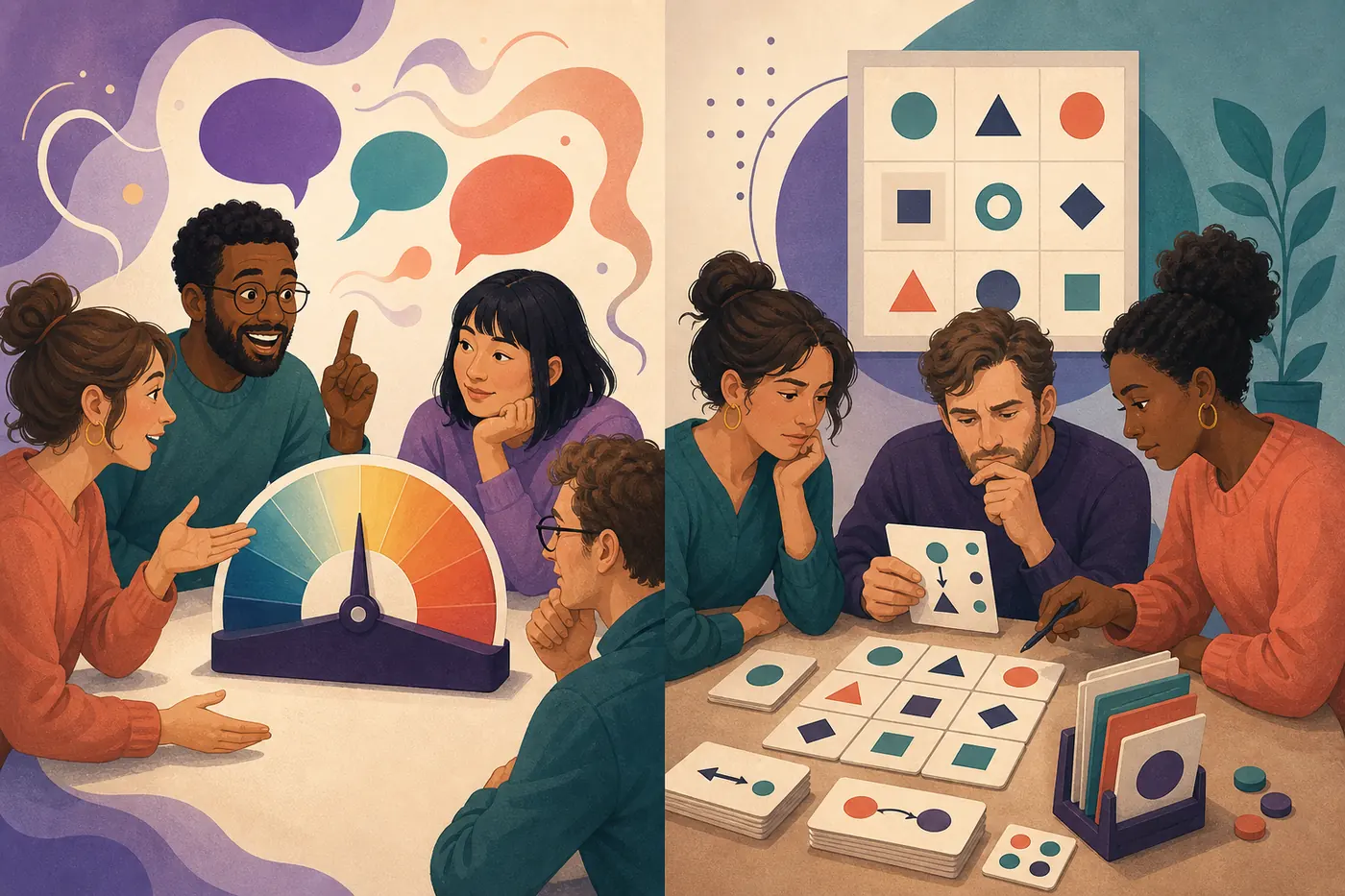
Editorial comparison of open clue discussion and structured deduction game mechanics
Editorial comparison: some Wavelength alternatives preserve open discussion, while others trade subjectivity for a more structured deduction puzzle.

Choose open interpretation for the closest social feeling

Dixit, Just One, and Herd Mentality are the closest when your favorite part of Wavelength is discovering what a friend considers obvious. Their rules leave room for personal associations, so explanations after the reveal are often as entertaining as the score.

Choose word grids for more tactical clues

Codenames, Decrypto, and So Clover! narrow the possible answers. That reduces free-form debate but creates more measurable clue skill. These are better choices for players who want to improve, track patterns, and feel that a clever decision—not only group chemistry—won the round.

Choose majority games for a larger casual crowd

Herd Mentality and Green Team Wins scale socially because everyone answers at the same time. They remove downtime and make the group's shared assumptions the puzzle. The tradeoff is that no single Psychic gets the spotlight and there is less space for one clue to develop into a long conversation.

Which Wavelength Alternative Fits Your Group?

Editorial illustration comparing party games for two players, four players, and a larger group
Editorial group-fit illustration: player count matters, but the desired mood—calm cooperation, focused clues, or party energy—matters more.

For two or three players

Most team alternatives weaken at two. Choose a cooperative title such as So Clover! where supported, or use a cooperative clue format like Just One with a small house-rule adjustment. If you specifically want the spectrum mechanism, read the small-group notes in our physical Wavelength review before replacing it.

For four to six players

This is the most flexible range. Codenames and Decrypto support real teams, Dixit has enough submitted images to create uncertainty, and Just One produces varied clues without becoming noisy. Decide whether your group prefers winning through deduction or laughing at personal interpretations.

For seven or more players

Prioritize simultaneous participation and simple turns. Herd Mentality, Green Team Wins, and Monikers reduce the chance that half the room waits for a private puzzle to finish. Codenames can also work, but a confident spymaster and a host who invites quieter opinions make a major difference.

Best overall decision rule: choose Just One for cooperative accessibility, Codenames for competitive wordplay, Dixit for creative interpretation, Decrypto for deduction, and Herd Mentality for a big casual crowd. If none of those descriptions sounds better than arguing over a spectrum, keep Wavelength and refresh the session with our 200+ Wavelength prompts.

What to Check Before Buying a Wavelength Alternative

  1. Identify the behavior you want to repeat. “Party game” is too broad. Decide whether the group wants clue craft, personal judgment, teamwork, performance, or majority prediction.
  2. Use your real player count. A game that technically supports ten may still create long waits. A cooperative game may support three but feel too predictable if the same people always think alike.
  3. Match the teach to the occasion. Just One and Herd Mentality suit a mixed crowd arriving at different times. Decrypto deserves a stable table willing to learn the first round.
  4. Check language and cultural load. Word-heavy games can disadvantage younger players, second-language speakers, or people outside the same pop-culture bubble. Concept and visual games reduce some of that pressure.
  5. Consider replay value for your group. Reusable systems matter more than raw card count. Wavelength stays fresh because people change their clues; Monikers stays fresh because earlier rounds create shared references.

FAQ About Games Like Wavelength

What game is most like Wavelength?
Dixit is closest to Wavelength's subjective interpretation, while Just One is closest to its accessible clue-giving and mind-reading. Codenames is the strongest alternative if your group mainly enjoys team discussion around a single clue.
Are there cooperative games like Wavelength?
Yes. Just One and So Clover! are strong cooperative alternatives. They replace the competitive spectrum guess with a shared word puzzle, so the table wins or loses together.
What are the best party games like Wavelength for large groups?
Herd Mentality, Green Team Wins, Monikers, and Codenames are better suited to larger groups because they create broad participation, clear teams, or simultaneous answers.
Is Codenames similar to Wavelength?
Yes, but the similarity is social rather than mechanical. Both use one clue to trigger team debate. Codenames asks players to connect words on a grid, while Wavelength asks them to estimate a position between two concepts.
Can I play a Wavelength-style game without buying another board game?
Yes. Use the free browser board on this site, choose prompts from the prompt library, and share the screen with friends. That preserves the spectrum mechanism without requiring another physical box.

Official Game References